Nosferatu Alucard[b] (Japanese: 不死者アーカード, Hepburn: Nosuferatu Ākādo?; IPA: [aːkaːdo̞]) is the trump card and pride of the Hellsing Agency, which works against vampires and other such supernatural forces running rampant beneath the public eye.
An expert vampire hunter, Alucard answers only to the Hellsing family, usually demanding orders from his master by repeating, "Give me your orders, my Master (命令をよこせ我が主)" until he receives a definitive answer. It has been implied that he is the most powerful vampire alive as a result of a century's worth of experiments done to him by the Hellsing family to create what is essentially the "Ultimate Undead."
Originally a Transylvanian vampire known as "Count Dracula (ドラキュラ伯爵, Dorakyura Hakushaku)," it was his defeat at the hands of Abraham Van Helsing—a mere human—that led to his servitude towards his descendants, a contract lasting for centuries. However, his defeat by him caused him to long for a definitive death at the hands of a human.
Character Data
Appearance
Appearance and shape hold no meaning for me. (姿形など私にとっては何の意味もない。) (Su gata katachi nado watashi ni totte wa nani no imi mo nai.)
—Alucard, to Walter C. Dornez (Order 76: Lunatic Dawn)
Alucard has stated on more than one occasion he can appear in any form he wishes, and the forms he takes on any particular occasion reflect no meaning or purpose.[33][34][5] As a result of consuming many lives, the fundamentals of his identity has been altered to the point where "form" is superficial to him; however, his original form is male, so he adopts a male form and is referred to as one.[25]

His inconsistent hair shape and length result from his power to willfully alter it, linked to his "shadow."[5] Alucard possesses pinkish-red pupils.[35] His teeth may also change from those of a typical human with slightly elongated canines to large and triangular in a manner somewhat reminiscent of a great white shark; his arm length exceeds typical proportions, and his clothing appears to repair itself when he regenerates.[36]
Alucard's distinctive gloves are visible in the vast majority of his transformations, even when he is not in a humanoid form. On the back, his gloves consist of a five-pointed pentagram inscribed inside a circle, with strange astrological or alchemical characters in the spaces between each of the points. There is a band of writing around the circle with the following inscription: "Hellsing ● Hells Gate Arrested ● Gott Mit Uns[c] ● And Shine Heaven Now." Outside the band are characters written in the Theban alphabet; using letter substitution, it becomes clear the runic words are English, spelling out "Hellsing," "Hells Gate Arrested," and "Shine Heaven Now." At the bottom of the circle, near the wrist, there is a square with rounded corners featuring four horizontal lines.
The "Normal Version (通常Ver., Tsūjō Version)" is the most common form he takes upon.[5] He appears as a tall, long-limbed, broad-shouldered adult man of indeterminate but reasonably young age. Although he can alter the length and shape of his hair, as it is part of his shadow,[5] he is typically seen with short, jet-black hair, with his bangs slightly falling into his eyes and strands framing his face.[37]
His usual outfit is comprised mainly of Victorian Coachman fashion; it includes a white, long-sleeved shirt with an intricately knotted red cravat under a black, double-breasted suit with red buttons, matching black trousers, and a pair of dark brown leather riding boots, covered by a red, split, and full-length long coat with ruffles exclusive to the shoulders.[38] On occasion, he also wears a red cowboy hat with a wide, floppy brim, the band replaced by multiple white stripes,[39][35][40] and a pair of white, circular, heavily tinted, pink-framed sunglasses with goggle sidings.[35][d]
.png "Unknown (41).png (220 KB)")


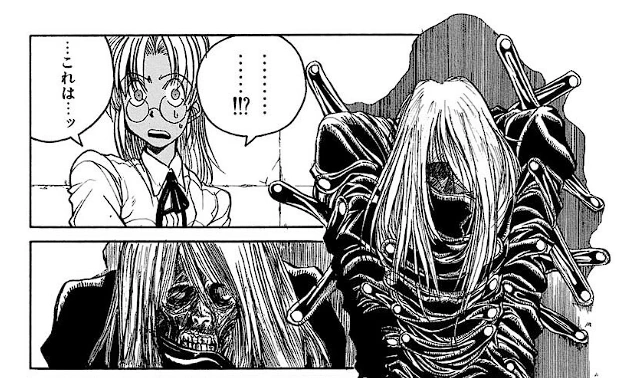
The Restriction Version (アーカード 拘束具姿, Ākādo Kōsokugu Sugata; lit. "Alucard in restraints") is the form Alucard shapes into when he releases Level One.[41] In this form, he has a disheveled hairstyle that varies in shape and length, and he accommodates different body types, whether bulky or lean, but his overall features remain consistent. He takes on the appearance he had when Integra Hellsing found him in a straitjacket that constrained his arms behind his back, featuring white hair, a result of ten years in confinement without access to blood.[42]
He is portrayed as wearing a white straitjacket, with several stripes across his front torso, shoulders, wrists, thighs, and ankles.[43][e] He has used it in his fight with Luke Valentine,[44] his fight with Tubalcain Alhambra[45] and Rip Van Winkle,[46][47] when he finally killed Alexander Anderson,[48] and in his fight with Walter C. Dornez.[49][50][51]


One of Alucard's alternate forms resembles a little child, which is referred to as "Young Girl Version (幼女Ver., Yōjo Version)."[f][5] In this form, he is petite and slender with straight dark hair that drapes just below his shoulders.
He wears a white office shirt under a white vest with a matching coat and scarf, white pants, white shoes, a white tie, a white trench coat, and occasionally, a fuzzy white cap.[g] Although he changed his looks, Alucard did not change his voice.


Alucard is also capable of appearing as he did during his reign as Vlad Dracula in a form referred to as "Count Version (伯爵Ver., Hakushaku Version)."[5] In this form, his general stature is unchanged, save for being perhaps slightly bulkier. His face appears to age from that of a young adult to that of the middle-aged man, and he grows a short, full beard and mustache.[h] His hair also increases in length to his mid-back and becomes wild and unkempt.
His attire changes from his usual suit to a full set of gunmetal grey plate armor and a tattered black cape with red inlay and a high collar, closed in by a rope.[i] He acquires a broadsword, which hangs from one of three belts at his waist.


Personality
I cannot be killed by dogs. (狗では私は殺せない。) (Inude wa watashi wa korosenai.)
—Alucard, to the GATE brigade (Order 15: Elevator Action (2))
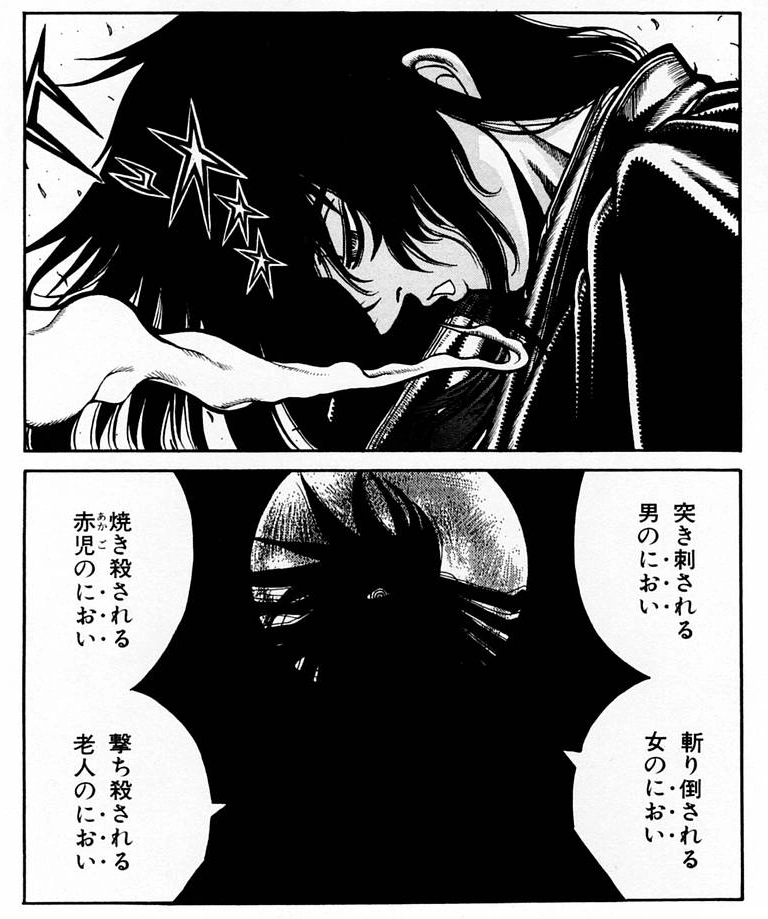
Alucard is brought to nostalgia by the scent of war
As he is essentially invincible, Alucard is very egotistical; he freely taunts and belittles his opponents,[52][53][54] although he does not hesitate to also pester his allies.[55][56] He fights with ferocity and often extreme cruelty, rarely shooting to kill until his target has been completely disabled and humiliated.[12][57][58][47] One of his favorite methods of fighting is to allow his opponents to inflict seemingly fatal wounds before simply flowing back together, as he asserts that dogs cannot kill him.[54] Having been referred to as a monster repeatedly, it is something he indulges in and takes pleasure from being.[59][60]
In war, he is merciless to those against him and his agency, even if they are human.[61][62][63] Though he seeks the scent of war,[64] he understands his status as a slave to the Hellsing family, bound to follow their orders.[65] However, even with his powers, he can be caught off guard, usually due to his arrogance.[66]
Alucard expresses extreme disgust with the vampires he has been hunting for the last 100 years, especially when they kill for the sake of "immortality."[52][53] He views immortality as a myth, believing that those who long for such are deceiving themselves.[67][11] Despite his disgust for homicidal vampires, he believes that transcending humanity is something one must earn that requires overcoming resignation, an act he detests.[68] He views his own transformation as an escape from death and a cowardly act of revenge against those who wronged him,[69][62] considering his actions of resignation represent the "essence of conflict" in which the losing side overturns everything they have in order to win.[70][71] In contrast, he happily gave Seras Victoria a choice to turn into a vampire due to her courage and will to continue fighting against the monsters in Cheddar Village.[68]
That which defeats a monster... is always a man. (化け物を打ち倒すのは、いつだって人間だ。) (Bakemono o uchitaosu no wa, itsu datte ningenda.)
—Alucard, to the GATE brigade (Order 15: Elevator Action (2))
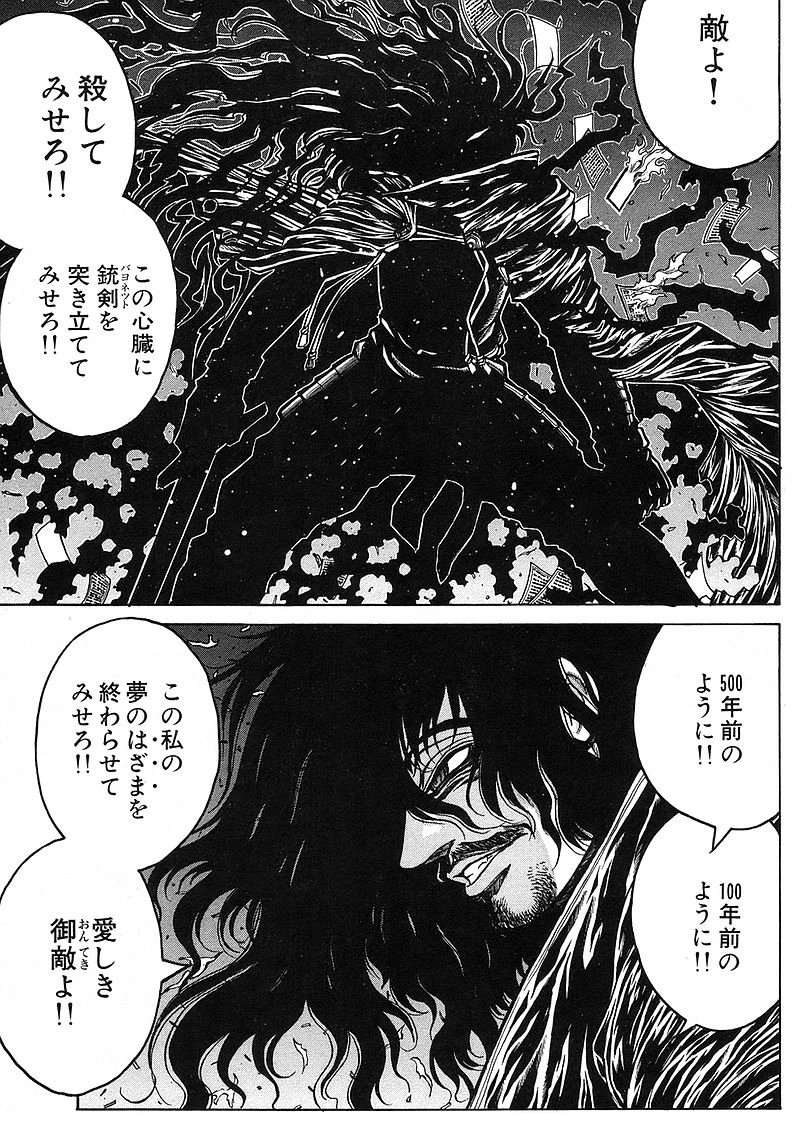
Alucard's wish is to be defeated by a mortal, as he was a century and five centuries prior
Underneath his arrogance, Alucard is deeply sad and appears to be envious of humans.[62] He shows great respect for humans who have the willpower to endure old age and death because he had none of these qualities when he faced death.[72][73][74][75] He repeatedly expressed his wish to seek a human opponent with enough willpower to end him despite his strength, often remarking that the one who defeats the monster is always a man.[76][69][77] In conjunction, he holds a great affinity for humans who take pride in themselves, thinking of himself as a "weak monster that denied God" who must be killed by a human.[75]
Humans he truly respects, such as Alexander Anderson, are those who manage to exceed his expectations and confirm his beliefs that humans are extraordinary.[78][79] Furthermore, his choice to serve Integra Hellsing was driven by the taste of her blood, which he perceives to be of "courage" and "determination."[80] He admired the efforts and length Van Helsing and his companions went through to defeat him and retrieve Mina Harker, enough to willingly enter servitude towards the Hellsing family.
Even so, Alucard does have some form of humanity left in him, since he is still capable of shedding tears[81][82] and showing affection for those dear to him, as he shows a great deal of it to Seras and Integra.[83][84] His affection towards Seras and Integra is genuine, as they provide him with a sense of belonging, even after he had lost everything twice.[85] Moreover, he understands that people did not choose to become ghouls themselves and are constantly suffering from the host's actions; thus, he seeks to eliminate ghouls in a single shot to circumvent their suffering.[86]
So. Did God descend? Did Jerusalem, the Paradise? Well? Answer me. King. Mad king. Everyone died. They all died. For your sake. For what you believe. For the sake of your paradise. For the sake of your God. For the sake of your prayers. Now they're all dead. You're no longer a king. Not even a servant of God. No, no longer a man. You killed enemies, allies... the subjects you were to protect, the country you were to govern... Men, women... The aged, children... Even yourself. (それで、降りて来たかね? 神は楽園は?どうした? 答えろよ、王様。狂った王様。皆死んだ 皆死んだぞ。お前の為に。お前の信じるもののために。お前の楽園のために。お前の神様のために。お前の祈りのために 皆死んでしまった。お前はもう王じゃない。神の従僕ですらない、いやもはや人ではない。敵を殺し、味方を殺し、守るべき民も、治めるべき国も、男も、女も、老人も、子供も、自分までも。) (Sore de, orite kita ka ne? Kami wa Erusaremu wa? Dō shita? Kotaero yo, ōsama. Kurutta ōsama. Mina shinda kai shinda zo. Omae no tame ni. Omae no shinjiru mono no tame ni. Omae no rakuen no tame ni. Omae no kamisama no tame ni. Omae no inori no tame ni mina shinde shimatta. Omae wa mō ō janai. Kami no jūbokude sura nai, iya mohaya hitode wanai. Teki o koroshi, mikata o koroshi, mamorubeki-min mo, osamerubeki kuni mo, otoko mo, on'na mo, rōjin mo, kodomo mo, jibun made mo.)
—Alucard, to himself (Order 68: Castle vania (1))
The source of his envy towards human pride stems from his renunciation of God and his transformation into a vampire, unable to accept dying as a human due to his hatred and perceived betrayal;[75][62] as a child, he was raised by the Turks and sodomized by the Sultan while clinging to his faith, which he believed was his only sustenance despite feeling betrayed by God;[87][88] as a warrior, he felt that true faith required action rather than mere words, leading him to pursue great and terrible deeds in God's name without ever asking for favors.[89] He gained notoriety for impaling his adversaries, both in his own lands and abroad, for waging a war against Muslims in hopes of bringing down "the New Jerusalem,"[90] and for sacrificing his troops and populace to further his ambitions;[91] he thought if he and his men put forth great enough effort and sacrificed, God would intervene on their behalf in time of need.[92]
His actions caused even his own people to fear him, and subsequently, only a small number of his peasants and soldiers arrived to aid him in his last battle. When he lost the war and was captured by the Turks, he failed to realize it was his selfishness leading to the destruction of his kingdom;[93] instead, he perceived God's betrayal and renounced Him,[75] licking the pool of blood beneath him and becoming a vampire.[94][88] His past beliefs and extremism—even he ridiculed himself in retrospect for believing in such a fantastical paradise and taking extreme actions to achieve it—led to fatal consequences, in which God did not save them from the Turks.[93]
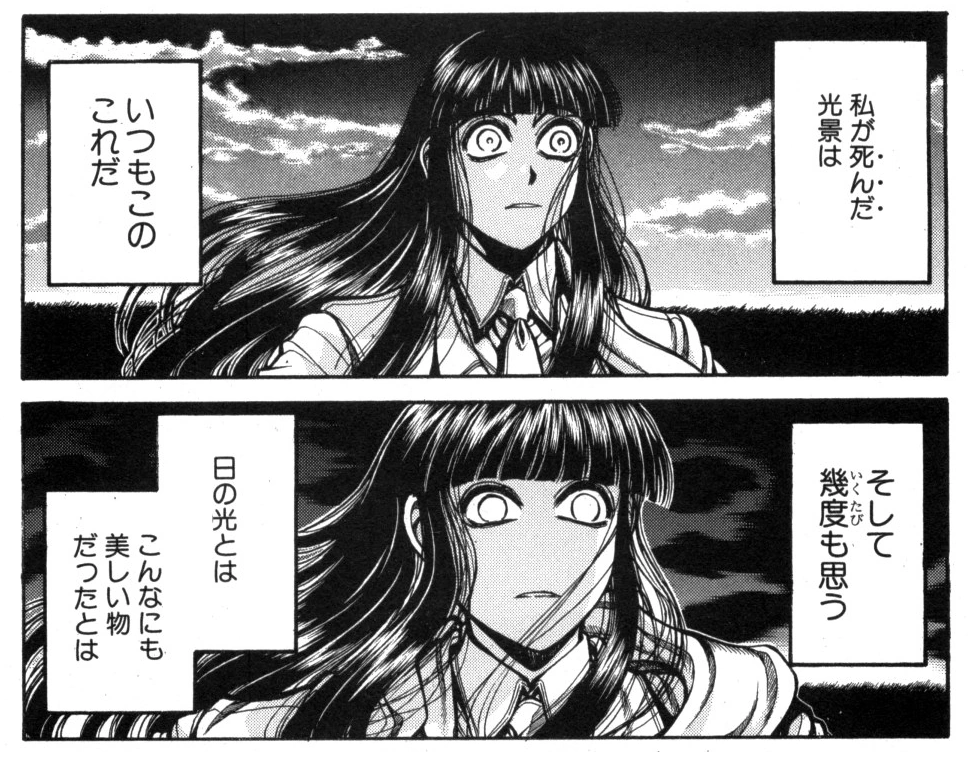
In each of his many deaths, the sun consistently shone brightly on him—a simplicity he never paused to appreciate
In truth, it was his hatred against those who wronged him in his youth driving his actions, and he used the name of God to mask his own hate and need for revenge. His sadistic tendencies had consumed him so completely that a sight as simple as a rising sun left him stunned by its beauty.[95][96] Thirty years later, he realized that he had people worth protecting and living for, no longer yearning for death at the hands of a mortal or hellbent on death wishes. In essence, he shattered his expansive past with his expansive future, and effectively, he retrieved his humanity after having lost his sense of self.
Relationships
- Abraham Van Helsing: Dracula underestimated Abraham Van Helsing and his allies, Quincey Morris, John Seward, and Arthur Holmwood, who were determined to save Mina Harker from his grasp.[97][98] Dracula was tracked down and defeated[95][99] despite having fought body and soul.[100] After his capture, he pledged servitude to Van Helsing and his descendants; the psalm on his coffin reflects this vow.[101] It was because of this defeat that he wished to truly be put down at the hands of a mere mortal, no matter the impossibility of such an event; consequently, he became deeply envious of the human pride.[79] The sight of Anderson's will and resolve to defeat him reminded him of Van Helsing's strength.[79]
- Integra Hellsing: Alucard and Integra Hellsing share a complex "master and slave" relationship.[j] He is deeply loyal to Integra,[105][105] referring to her as his "beloved master," a testament to his undying devotion.[106] His recognition of her status as his "one true master" came when he tasted the grit in her spilled blood during her youth.[107][80] This sparked his fascination with her humanity, often testing her will.[108] He perceives himself as her weapon, deferring the choice to kill to her intent, even though he would not hesitate to act himself.[56][109][107][110] Integra's moments of trepidation and uncertainty when lending him orders to kill only arouse him;[56][105][111] thus, he does not refrain from teasing her, questioning whether his violent displays stir her blood.[108]
Upon returning to London, Alucard prostrates before Integra, who greets him with the title "Count." In turn, he refers to her as "Countess."[112] Integra is the only one whom he will obey and whose honor he will actively defend.[113] Seconds before his disappearance, he tenderly bids her farewell despite her desperately given orders for him to remain.[114][115]
After spending 30 years killing the absorbed souls to regain control over Schrödinger's essence, he reveals his return to her first, as he manifested in Integra's room. When she sorrowfully tells him of her old age upon realizing that he tried to drink her blood, he states his indifference towards her age. While seated before her, Integra bit her ring finger, drawing blood, and let it fall into his mouth, welcoming him back as "Count"; in turn, Alucard greets her as "Countess," telling her that he is home.[85]
- Seras Victoria: Alucard holds deep feelings of admiration towards his fledgling, Seras Victoria. He acts as her mentor to help her reach her full potential as a vampire.[42] He reveals to Walter C. Dornez he turned her into a vampire on a whim,[116] based on her own accord to live.[117] In truth, he is intrigued by her willpower, citing her as an example of a human who gains the privilege to transcend humanity by rejecting resignation.[118][119] Even so, he was frustrated by her refusal to drink blood, criticizing her choice and her ineptitude. However, upon noticing her distress, he remarked on a suitable place for a "timid evening walker" like her;[55] nonetheless, he remained confident that eventually she would drink.[120]
Upon reuniting with Integra and Seras in London, he affectionately pats Seras on the head and calls her by her full name, acknowledging her.[83] Her voice pulled him from his stupor in his battle against Anderson—the last visage in his dream was her face,[121] enough to restore his will to fight.[122] Before confronting Walter, Alucard realizes her growth and orders her to proceed with Integra and confront The Major.[84] Subsequently, he refers to her as his beloved servant,[106] and in the end, she remains the only one who confidently believes in his return.[85]
- Alexander Anderson: Alucard and Alexander Anderson have a fierce rivalry that resembles kinship; their similarities and opposing natures drive both their intellectual and physical combat as they recognize each other as arch-enemies.[123] The two almost seem content to live so they can fight each other; they engage in combat immediately upon sight, without exchanging words.[124][125] Nothing else comes close to exciting him besides a confrontation with Anderson, who affirmed his beliefs that humans are magnificent and dreamlike beings.[78][79][126] He admires Anderson's willpower, likening him to Van Helsing and his allies,[79] referring to him as his "beloved mortal foe."[127] As such, he was content with the idea of Anderson killing him.[127][128]
Even then, their fundamental beliefs are starkly different as Anderson chooses to forsake his humanity and become God's weapon, something he wished he had been born as, despite Alucard's urgent pleas.[129][130][131] He condemned Anderson's actions, believing Anderson had succumbed to the same "essence of conflict" that he had.[71] He detests the way Anderson had become someone else's will, seeing in him the weaknesses that had led to his own transformation into a vampire;[75] hence, he is overcome with emotions once Anderson is defeated and cries.[82]
In solace, however, Anderson attempts to comfort Alucard in a fatherly manner.[132] Alucard contemplates encountering Anderson again in Limbo as former, respected rivals, but he intends to live until his expansive past is shattered by his expansive future.[133] When Anderson falls upon his final prayer to Alucard, Alucard smiles as he utters "Amen."[134][131] Despite Walter's desecration of Anderson's corpse,[135][136] Alucard remains in a kneeling position as Anderson's ash courses through the wind, barely responding to the commotion while he stares down solemnly.[137][138]
Background
Early Life
God... Dear God. I will never... beg you for mercy. (神様。神様。私は決してあなたに慈悲を乞いたりはしません。) (Kamisama. Kamisama. Watashi wa kesshite anata ni jihi o koi tari wa shimasen.)
—Alucard (Order 68: Castle vania (1))
Vlad III was born in 1431 in Wallachia (modern-day Romania) as the son of Vlad II.[24] In 1444, Vlad was sold into slavery and sodomized by the Sultan of the Ottoman Empire (modern-day Türkiye); he was released by the Ottoman Empire in 1447.[24] Raised as a devout Catholic, Vlad believed that prayer could not be achieved through begging but instead through battle in service of God.[94]
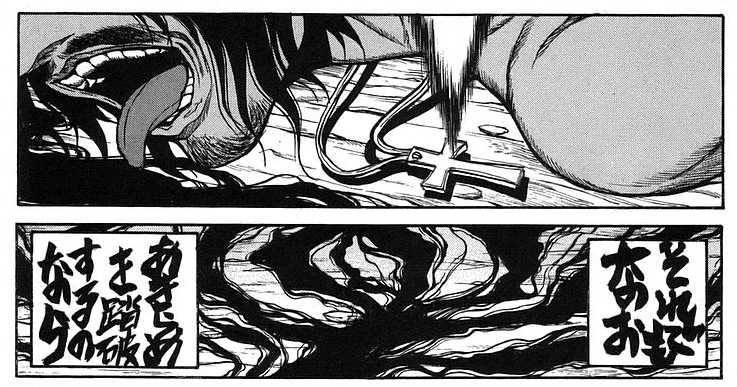
Feeling that he was abandoned by God, Vlad renounces Him, turning into a vampire
Upon assuming the position of Voivode of Wallachia, he initiated a military campaign against the Ottoman Turks.[139] In 1476,[24] after years of conflict, his forces suffered defeat, his subjects faced slaughter, and his homeland was set ablaze. Vlad was ultimately captured by the Turks and sentenced to execution.[94] In the moments before his beheading, he licked the blood pouring in front of him, thereby renouncing God and transforming into a vampire; the silver cross he had perpetually borne shattered beneath the force of the axe.[140]
Following his transformation into a vampire, Vlad would regenerate and attack the Ottomans, absorbing many as familiars, including his own men.[141] Establishing a domain in Transylvania, Vlad would become known as "Count Dracula."[88][24]
Dracula
- Main article: Dracula (novel)
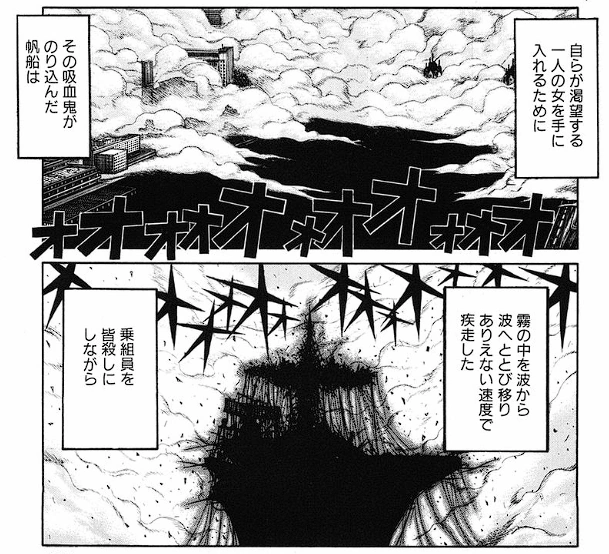
Once, a vampire came to England. To get a woman he personally desired... The vampire sailed aboard a schooner. The schooner dashed from wave to wave through the fog at unbelievable speed. The entire crew was killed. And so, the ghost ship, fully laden with corpses and caskets, made port in London. Her name is the Demeter. In Russian, the Demitri. (かつてある吸血鬼が英国にやって来た自らが渇望する一人の女を手に入れるためにその吸血鬼がのり込んだ帆船は霧の中を波か波へととび移りありえない速度で疾走した乗組員を皆殺したしながらそして遂に死人と棺を満載した幽霊船はロンドンへ着港した船の名はデメテル号ロシア語でデミトリ号である。) (Katsute aru kyūketsuki ga Igirisu ni yattekita mizukara ga katsubō suru hitori no on'na o te ni ireru tame ni sono kyūketsuki ga nori konda hansen wa kiri no naka o nami ka nami e to tobi utsuri arienai sokudo de shissō shita norikumiin o minagoroshitashinagara soshite tsuini shibito to hitsugi o mansai shita yūreibune wa Rondon e ki minato shita fune no na wa demeteru-gō Roshiago de demitori-gōdearu.)
—Narrator (Order 57: Wizardry (1))
In 1987,[24] Dracula became infatuated with Mina Harker, a British woman.[142] Following his travels to England, he feasted upon her, resulting in her absorbing his essence and turning into a servant vampire; subsequently, Abraham Van Helsing formed a coalition of vampire hunters, including Arthur Holmwood, Quincey Morris, and Jack Seward, undertaking the task of freeing Mina from her curse and confronting Dracula.[98] The coalition tracked down Dracula back to Transylvania via Mina's telepathic link.
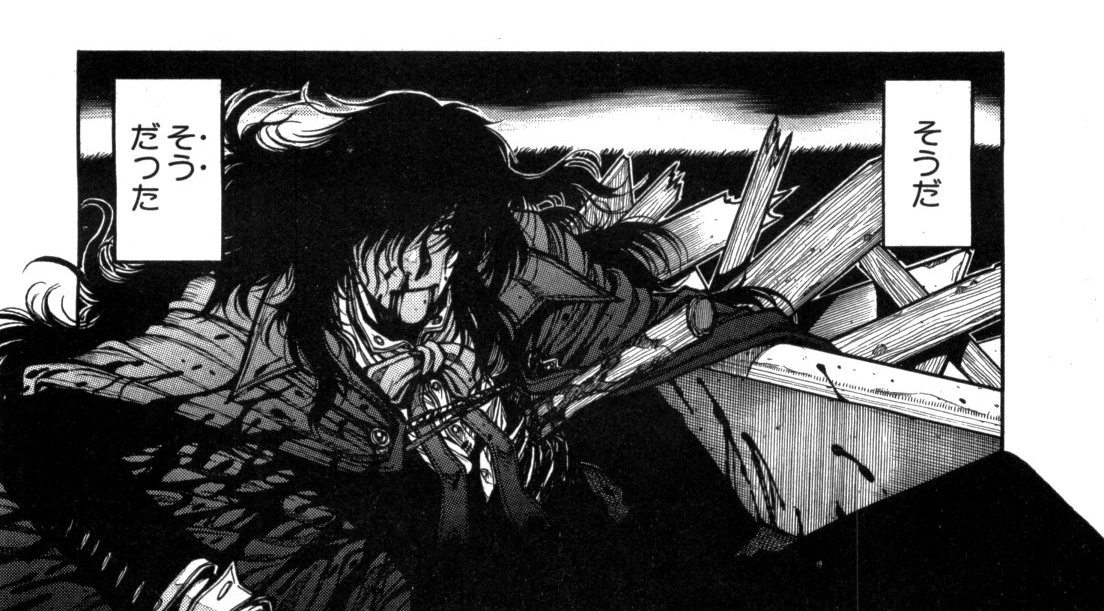
Dracula's defeat at the hands of a group of vampire hunters
They ultimately succeeded in defeating him, destroying everything in his empire.[143][99] With his defeat, Mina would seemingly return to normal after her wafer mark had disappeared, however, Dracula's essence would remain hidden deep inside her.[144] Following his defeat, Dracula's remains were transported to England, where they subjected him to experimentation utilizing the occult knowledge of Van Helsing,[145] who would later establish the Hellsing Agency in England.[24] This process included efforts to enhance the vampire's abilities for use as the trump card of the agency,[6] bounding him into servitude.[4]
The experiments conducted on him transformed Dracula into a dark mass of shadow matter, allowing him to shape his form as he wished; to control him and his forms, Van Helsing placed restrictions on his power using the "Control Art Restriction System."[25]
World War II
- Main article: The Dawn (arc)
In 1944, Dracula, now codenamed "Alucard," was sent by the then-master of the Hellsing family, Arthur Hellsing, in a coffin, accompanied by Walter C. Dornez, to a secret Nazi Germany hideout located in Warsaw, Poland, under the suspicion of the mass production of an Artificial Vampire program.[146][24] Although he and Walter managed to destroy the operations, the key figures behind the operations managed to evade capture.[147][148]
Confinement and release
Arthur was aware of the danger of Alucard. That's drastic medicine, he said. Too dangerous to use as an elixir. So he sealed Alucard underground. (アーサーはアーカードの危険性に気がついていた あれは劇薬だと薬として用いるには危険すぎると だから彼はアーカードを地下に封じた。) (Āsā wa Ākādo no kiken-sei ni kigatsuite ita are wa gekiyakuda to kusuri to shite mochiiru ni wa kiken sugiruto dakara kare wa ākādo o chika ni fūjita.)
In 1969, fearful of the danger Alucard presents, Arthur confined Alucard in the underground dungeons of the Hellsing Headquarters.[149] However, in 1989, Arthur's daughter, Integra Hellsing, released Alucard after seeking asylum from the dangers her uncle presents with guidance from her late father, who had designated her as the agency's successor and told her of a guardian located in the forgotten basements of the headquarters if the need arises.[42][150] A one-sided confrontation ensues when he chooses to serve Integra as his one true master and decimates Richard.[42]
Capabilities and Arms
| Control Art Restriction System |
|---|
| 拘束制御術式 |
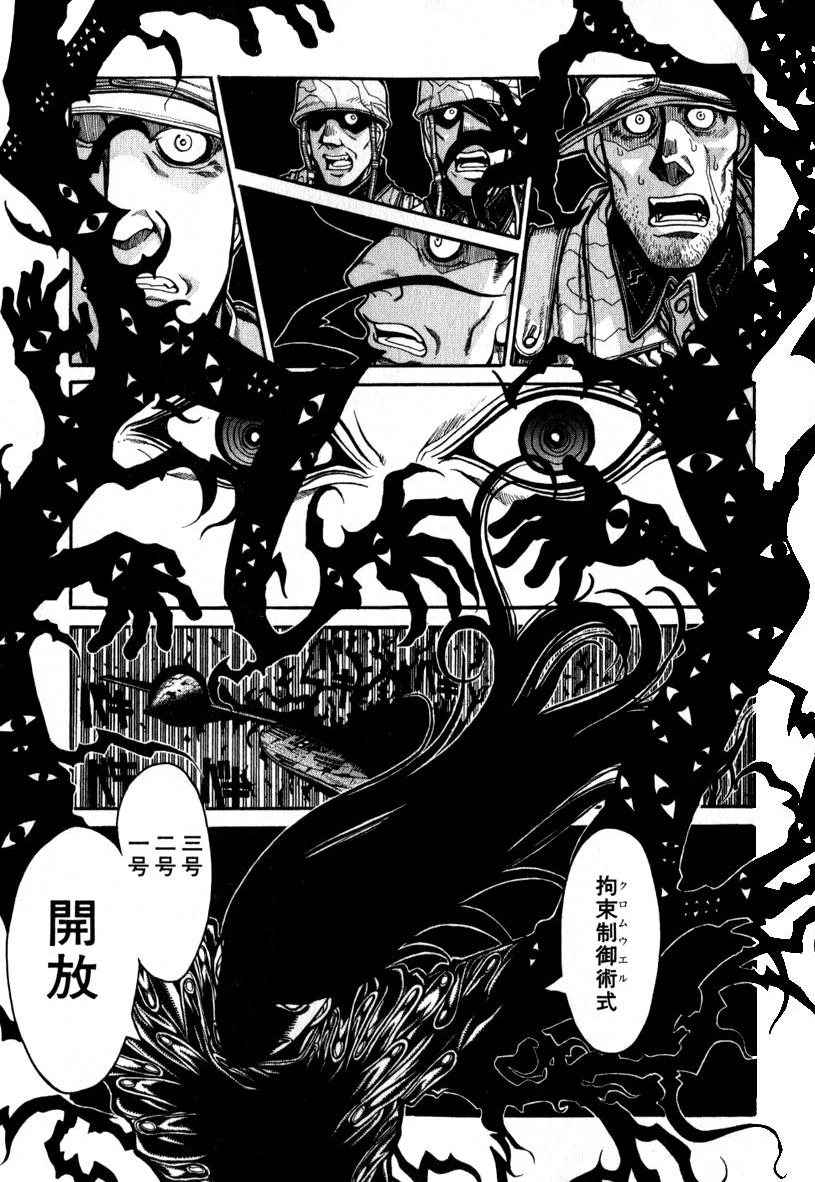 Alucard releasing restriction to Level One Too powerful to be left on his own, Alucard's powers are restricted by the "Control Art Restriction System" which has to be accessed through the "Cromwell Approval" mechanism.[151][152][153] The restriction in place suppresses the many lives that Alucard had consumed to the point where it altered the fundamentals of his identity.[25] The source and mechanism of the restriction are engraved on his gloves, which are inscribed with the Hellsing seal. With four Levels of restriction, where lower values equal greater levels of power, the release of lower Levels is restricted until the target is eliminated, and their release depends on the target's powers.[151][153] He is able to release Levels up to Level One independently, while Level Zero requires the explicit approval of his master.[154][155][153][145] |
| Real Vampire |
|---|
| 本物の吸血鬼 |
Alucard is an extremely formidable and deadly opponent who can cut down most supernatural enemies without releasing the seals containing his true power. He often allows his opponents to tear him asunder, only to regenerate wholly as a way to taunt them.[156][54][157] He demonstrates several unique abilities as well as the ability to regenerate from virtually any injury.[153] The following are Alucard's powers gained from both his being a vampire and years of occult research by the Hellsing Agency.[6] |
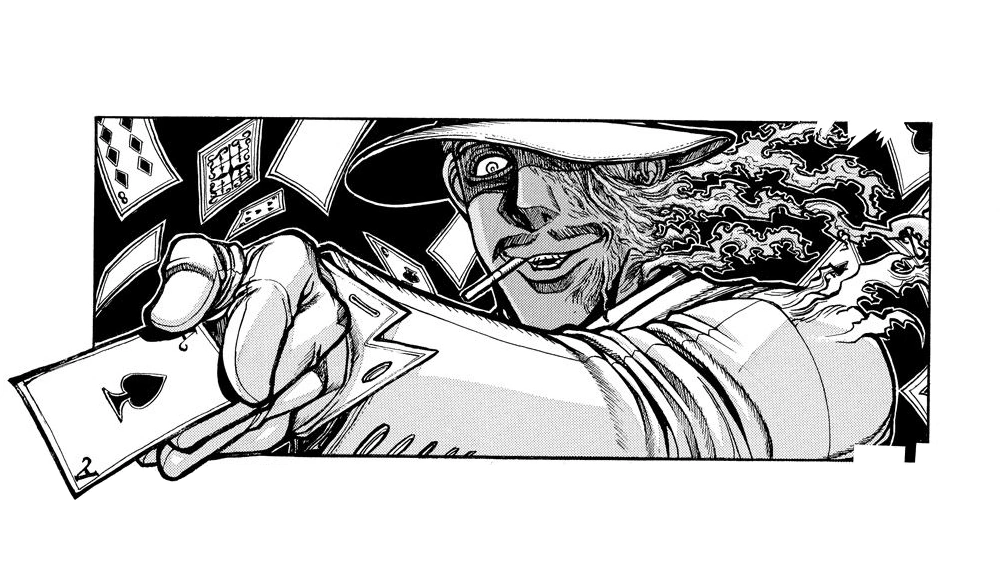
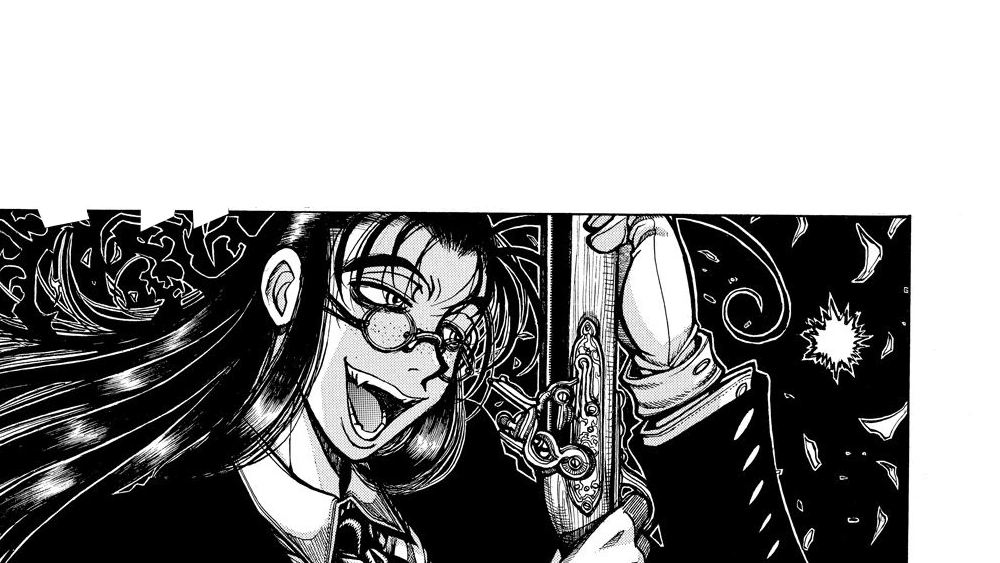
- Superhuman Strength: As a Real Vampire, Alucard is inherently strong.[158][159][153][28] To start, his guns, the Jackal and .454 Casull, are far too unwieldy for a human to hold,[160] let alone use, but he does both with ease.[161][153] He has gone up barehanded against even some supernatural weapons and destroying them, such as Tubalcain Alhambra's Playing Cards.[162] He is able to disembowel and tear apart several humans with one hand, despite their armor.[163][164][158][165]
- Superhuman Speed and Reflexes: Alucard is too fast for the human eye to follow,[158][159] but specific vampires such as Tubalcain[166] and Walter,[49] and Regenerators like Anderson,[167] can keep pace with him just fine. His reaction times are top-notch,[158] letting him catch Rip Van Winkle's Magic Bullet with his teeth,[168] despite a single one of these bullets penetrating an EXP-14LIE multiple times while the plane was moving as fast as possible.[169]
- Superhuman Durability and Endurance: Being heavily durable,[158] Alucard takes most damage without flinching or making a sound, quietly allowing the enemy to attack before retaliating tenfold.[156][54][157] After Rip Van crashes his Blackbird, he exits the craft without a scratch; subsequently decimating everyone aboard, even as they use high-caliber weaponry on him.[170] He has been thrown through skyscrapers[171] and bled excessively.[172]
- Telepathy: Alucard is able to communicate telepathically Seras, his fledgling. The telepathy does not seem to have a maximum range.[173][174]
- Resistances to Vampiric Weaknesses: While Alucard still possesses some vampiric weaknesses, the few he has are greatly diminished. While holy weapons and items made of silver do more damage to him than mundane arms, the level of damage and his reaction are far less than an average vampire's and do not leave any serious lasting injuries, which are regenerated but slightly slower.[167] Although immune to the sun, he has mentioned that staying awake during the day simply makes him tired, and he simply hates it while not considering it a great enemy of some sort.[175][176][153]
Hematophagy: As a vampire, Alucard can consume blood raw.[158][153] He has long, conical fangs to assist in this job as well as a serpentine-like tongue.[177] His feeding habits have been seen to vary: from traditional neck-biting[178][179] to simply tearing people apart and outright devouring them.[42][58]
|
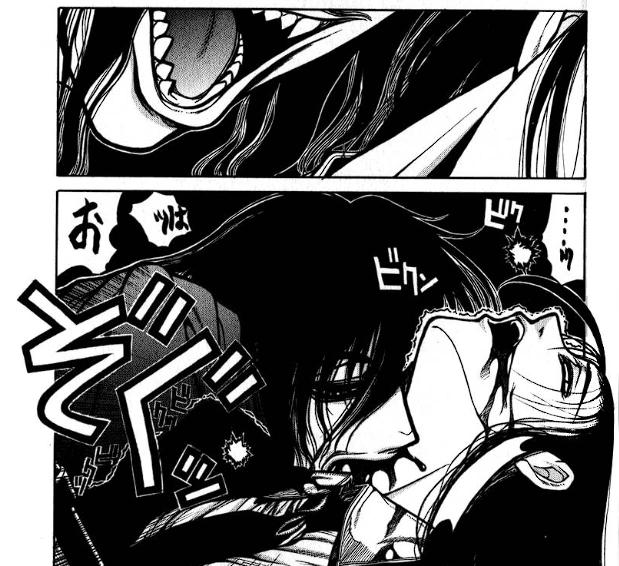
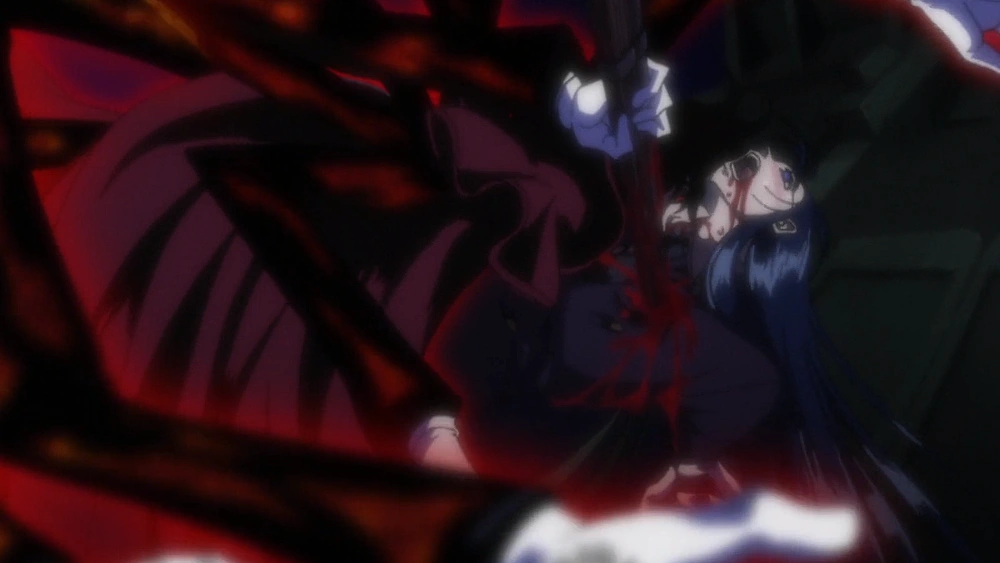
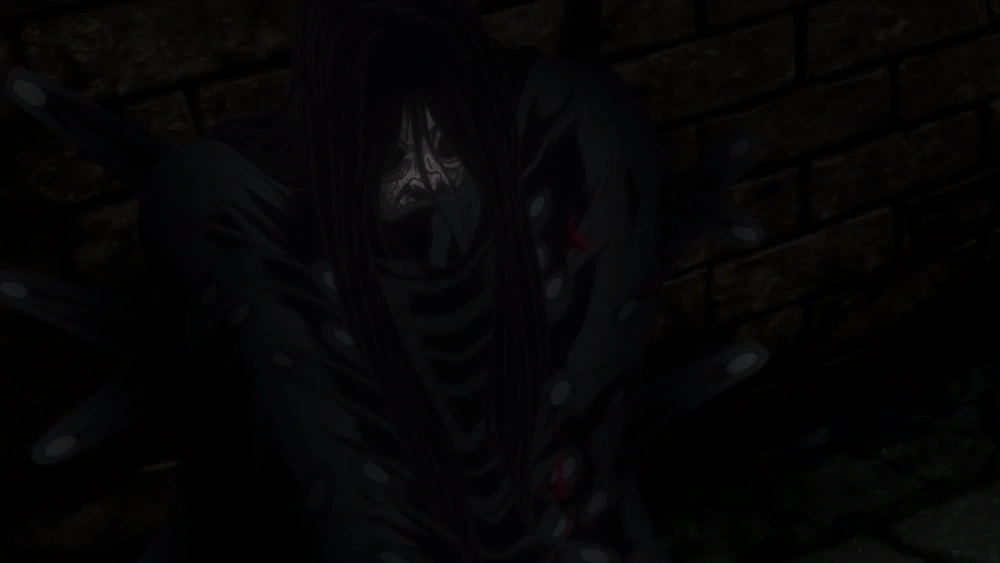
| Hemokinesis: Alucard has the ability to manipulate blood.[180][181] This ability seems to be limited to blood outside of the body, as he is never seen influencing the blood of enemies while they are intact. |
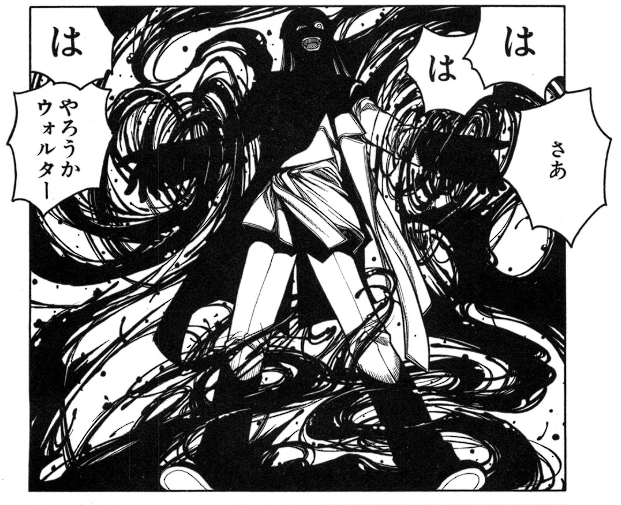

| Enhanced Regeneration: Alucard has the ability to perfectly and quickly recover from any physical injury.[158] He has been torn to shreds by conventional weaponry and has survived all of it.[156][54][157] Holy weapons, while they do affect him more, are regenerated all the same.[182] |
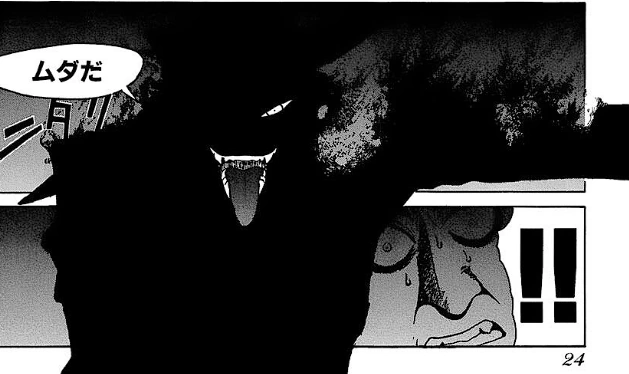

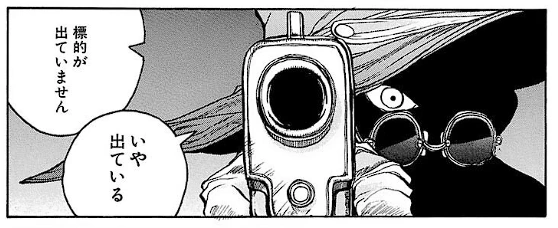
Third Eye: Alucard has senses that are not only sharper than a mortal's, affording him abilities such as perfect accuracy,[159] but he has abilities they completely lack. In particular, he possesses a "third eye," which allows him to see things from far, far distances.[183] This is not an inherent ability and must be used consciously, as he was unable to see through Tubalcain's illusionary clones.[184]
|
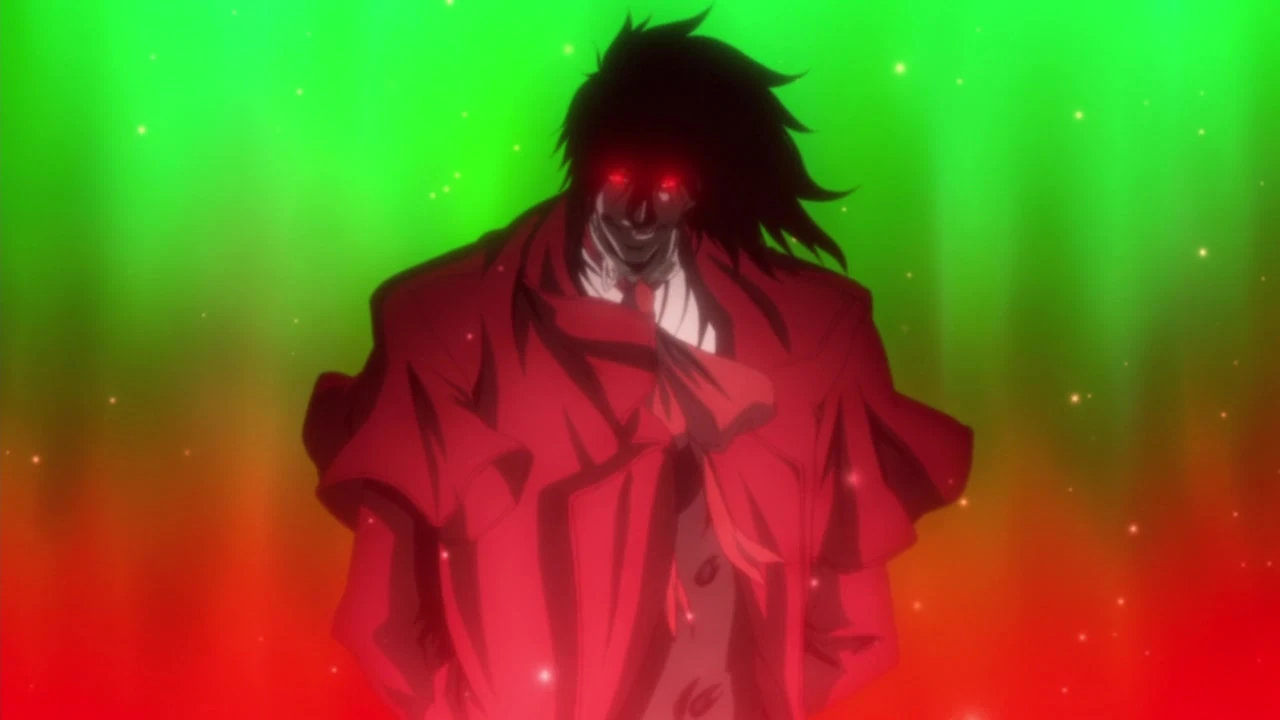

| Dark Composition: Though he generally dons a corporeal, humanoid form, Alucard is made up of a highly variable otherworldly substance.[46][47][16][188] This can be especially seen whenever he takes heavy damage, the darkness being immune to conventional weaponry.[189][190] Along with composing his being, it can serve as a weapon.[165] |
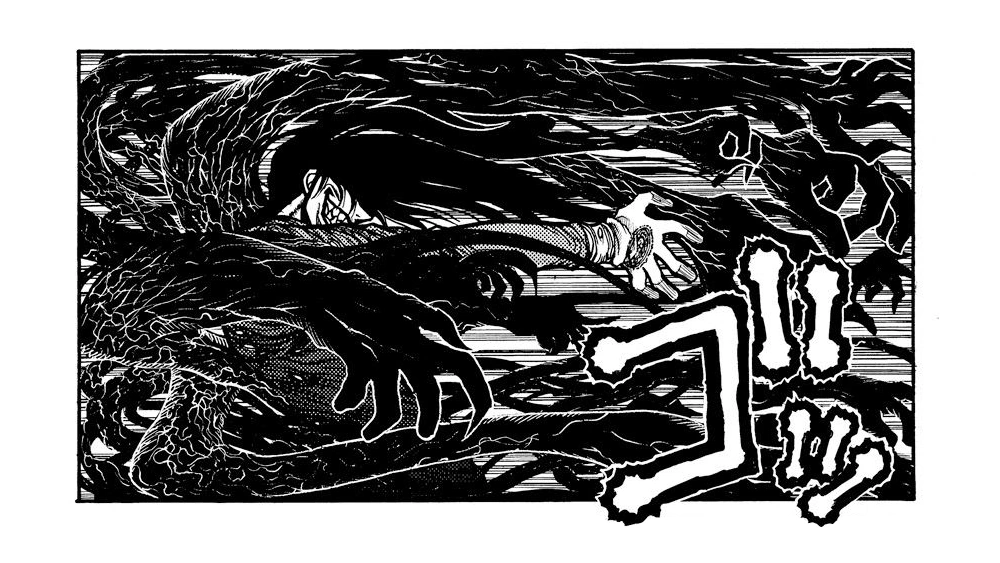

| Intangibility: Alucard has the ability to walk through solid objects, such as walls.[191] |
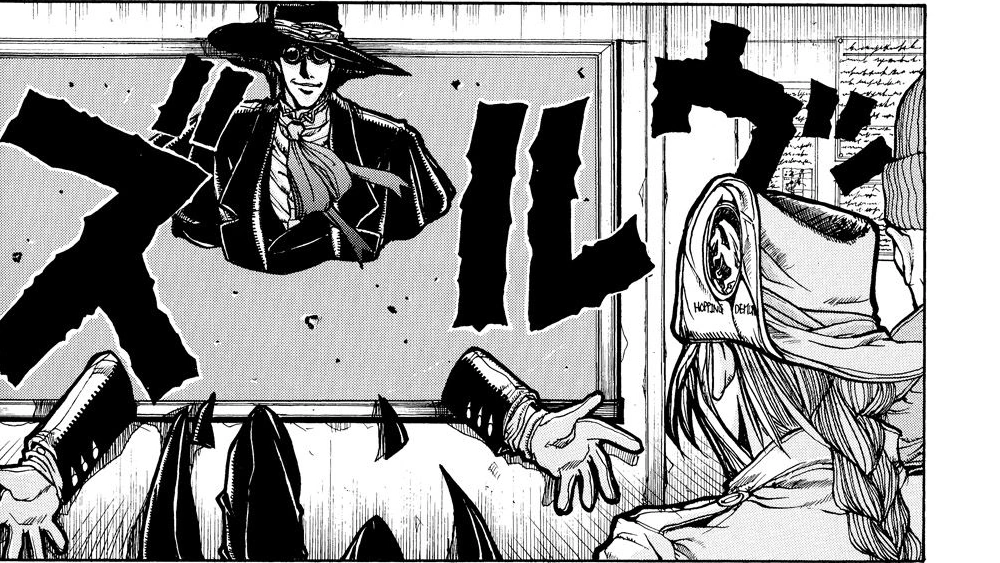

Shapeshifting: Alucard states appearance and shape hold no meaning for him.[33][34] He has changed into a child,[192] several bats,[193][194] and amorphous darkness,[46][47][16] and he has several forms.[5]
|
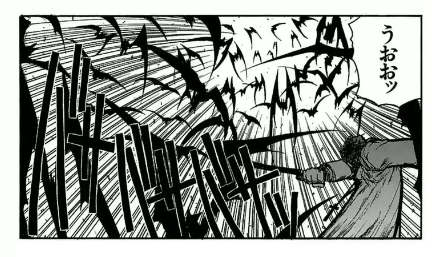


| Teleportation: Alucard is able to vanish and reappear at a different location.[196][174][197] The range in which he can teleport from is unknown. However, he is limited by his inability to cross large bodies of water.[198] |
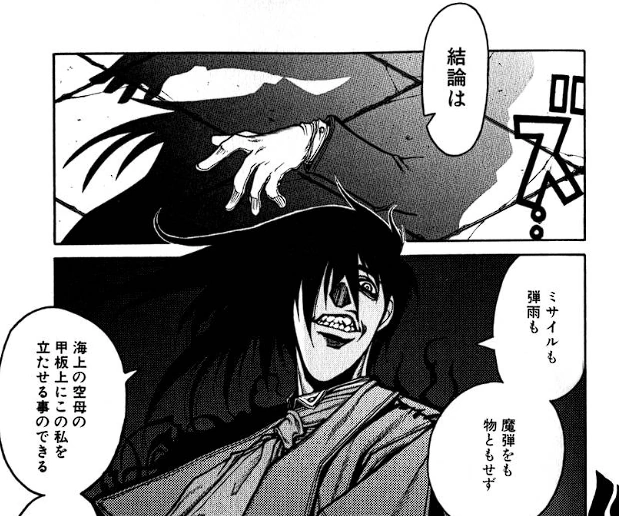

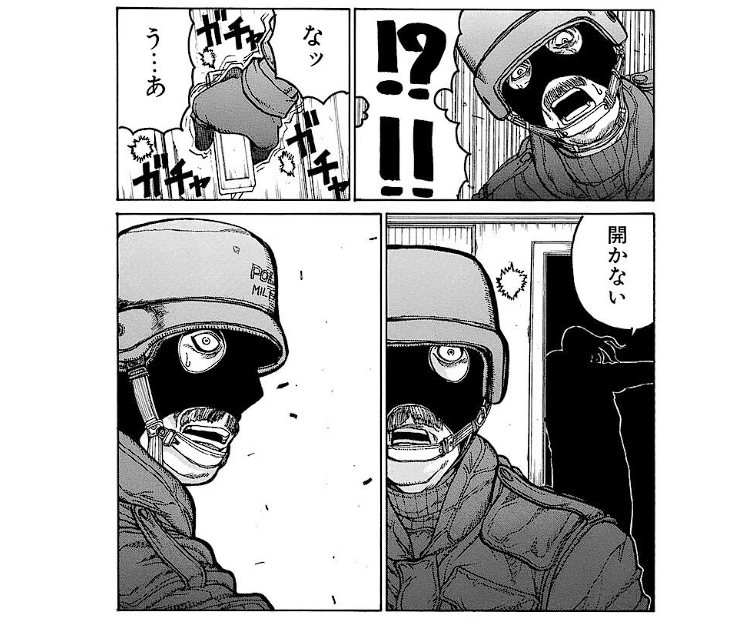
| Telekinesis: Alucard showed said ability when he slammed the door shut when the GATE team attacking him in the hotel tried to escape,[199] later tossing all of the GATE team out of the hotel to impale them on flagpoles[200] and using this ability to move the Eagle to London overnight.[201][202] |

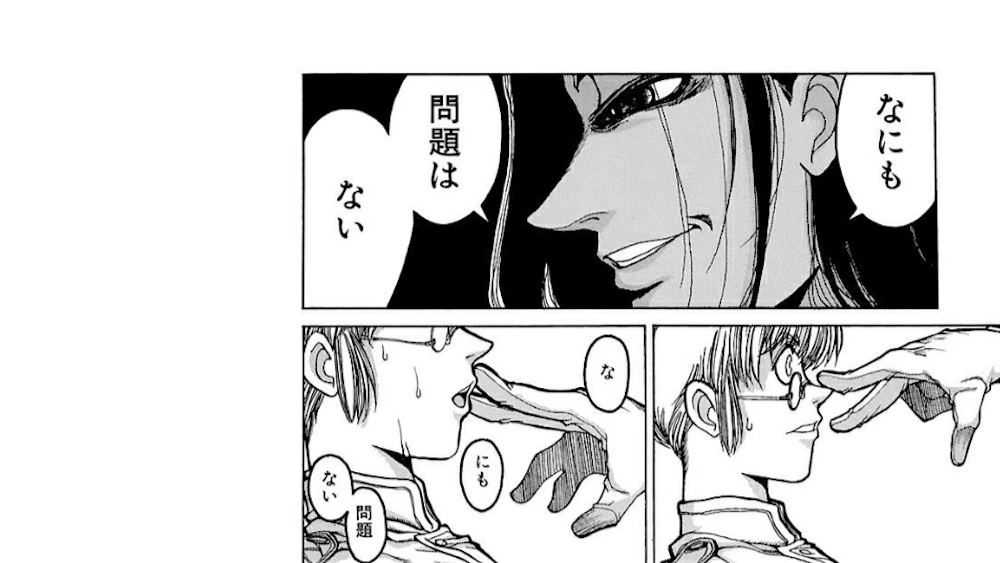

Hypnosis: Alucard has the ability to control minds, doing so exclusively with humans.[203][204][188][k] They will be pliant to all of his designs, doing and speaking as he wills; this hypnotic link is established through direct eye contact and does not waver, even when his attention is elsewhere.[203][204]
|
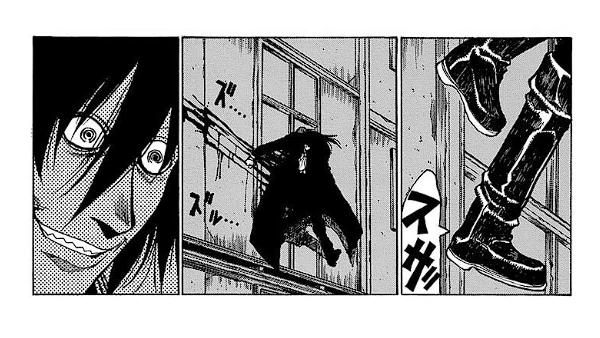
| Gravity Defiance: Alucard, during his fight with Tubalcain, is shown not only to be able to stand vertically on a wall but also run backward up it, indicating some sort of an ability to defy gravity.[208] Furthermore, when reaching London with the Eagle and situated on the Thames River, he leaped great distances and landed down within the center of the Ninth Crusade forces.[209] |

| Weather Manipulation: Alucard possesses the ability to control the weather to an unknown limit, as demonstrated by the fog created when he returned to London aboard the Eagle, concealing the ship from detection by Section XIII.[210] Later clearing the fog as soon as the Eagle is aboard the Thames and he enters the battlefield.[211] |
| Soul Aborption | |||||||||||||||||||
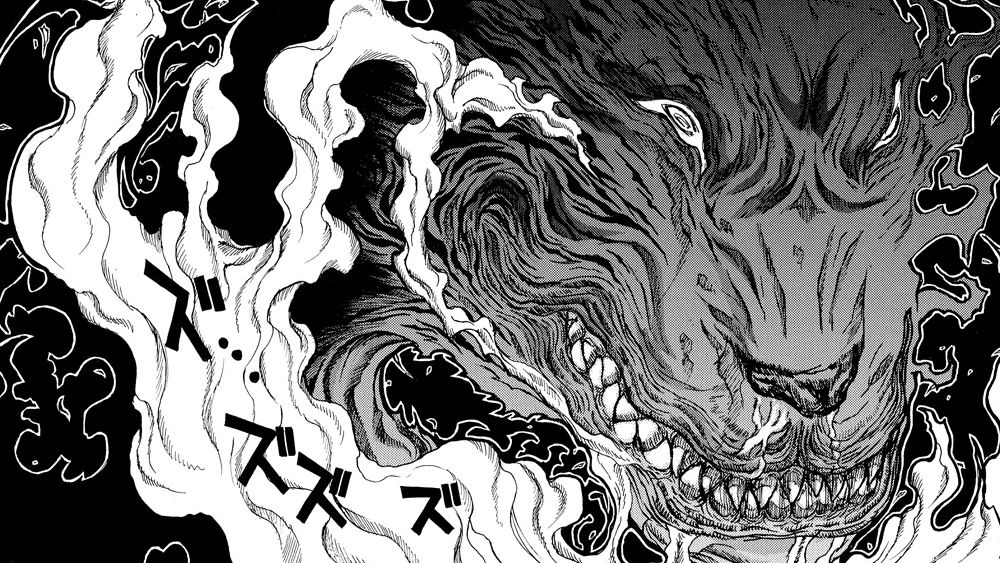
| The reservoir of souls Alucard had stored in himself through the sucking of blood, whether human or unhuman, which he had accumulated over centuries, was the key to his seeming "immortality."[212][153][213] By draining a person of their blood, he gains dominance over their soul,[214][215][216] while also taking the knowledge they possess.[178][217] Unlike Seras, Alucard seems content in dominating everything inside him.
|
In order to regenerate from fatal injuries, such as a decapitation or heart impalement, he would sacrifice one spare soul.[218][212][219] Therefore, it would require killing him over a hundred thousand times to truly end him.[212][220] However, with Level Zero separating him from the lives he had taken, he became vulnerable; if someone managed to impale his heart, he would truly be killed.[221][222][51][223][224]
| ||||||||||||||||||
| In 1999, The Major's sacrifice of nearly his entire battalion and all of the Vatican's Ninth Crusade led to a once-in-a-lifetime chance in which he could be killed. His familiars were eliminated by Anderson, leaving him only with Baskerville, which included Luke Valentine. The Major allowed Walter this opportunity as part of the deal. However, as Alucard rebuilt his fortress, his soul supply grew to millions, ending Walter's chances of killing him.[224] However, born from this instant came another opportunity to temporarily beat him by exploiting his ability to absorb the essence of life.[14][225]
| |||||||||||||||||||
| |||||||||||||||||||

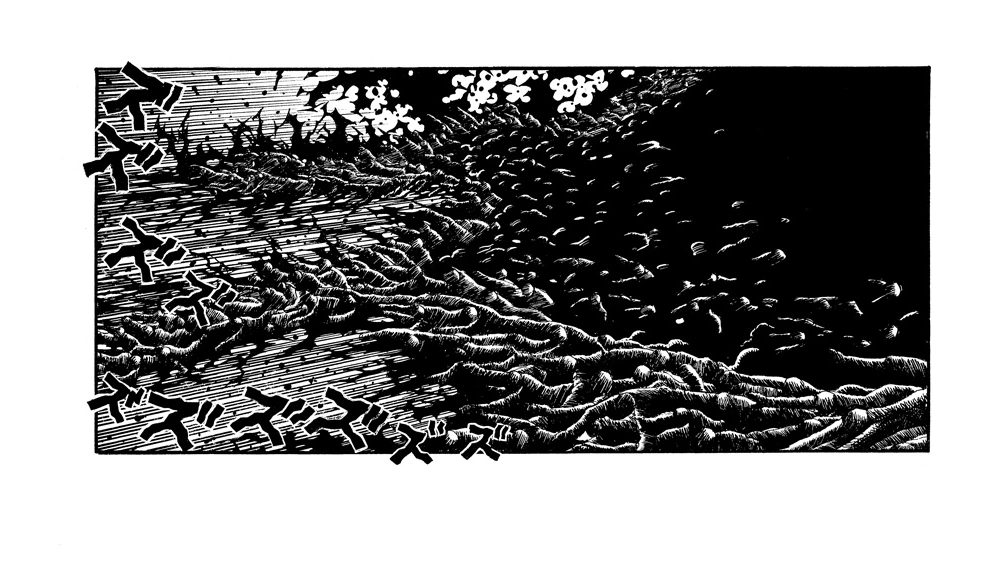

| Arms |
|---|
| 武器 |
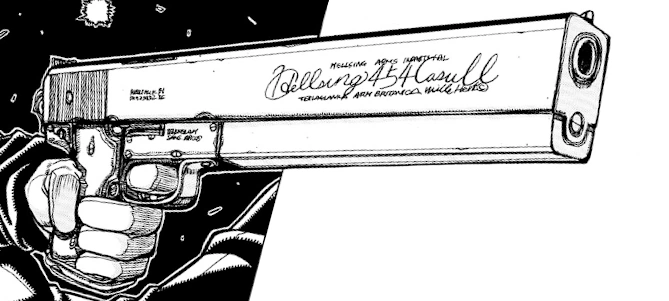
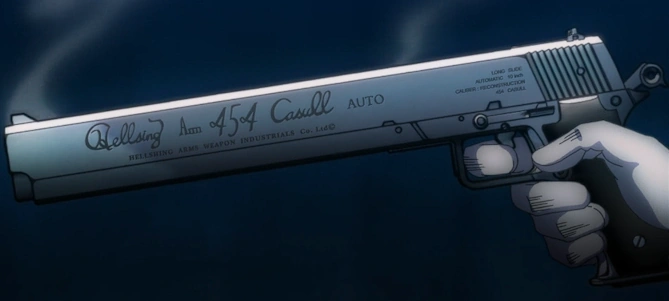
Alucard is an exceedingly lethal combatant even when unarmed, due to his extensive supernatural abilities and strength, but he also uses various weapons in battle—these have included swords and machine guns. Additionally, he has two signature weapons: a pair of intimidating, high-powered semi-automatic handguns named the .454 Casull and the 13mm Jackal.[153] |
| Hellsing Arms .454 Casull Automatic .454カスルカスタムオトマチック
| |
|---|---|
| The .454 Casull is a semi-automatic magnum pistol, based on two pre-WW1 handgun designs by Colt: the M1903 and M1905 pistols (the early versions of the M1911). The overall design of the .454 Casull is simple, using the Browning short recoil mechanism; its most recognizable feature is its long slide, counteracting the weapon's heavy recoil with its weight. The .454 Casull is 13 3⁄16" long, weighs 8.82#, and has a magazine capacity of seven 13mm explosive steel rounds, a modification of the original .454 Casull rounds. The barrel is 10" long and finished with titanium nitride, which gives it a characteristic gold color. It is too heavy and unwieldy for a human to use, yet a perfect match for his strength.
| |
| Hellsing 13mm Anti-Freak Combat Pistol "Jackal" 対化物戦闘用13mm拳銃「ジャッカル」
| |
|---|---|
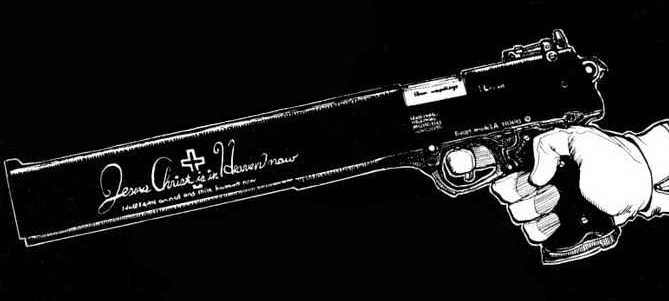
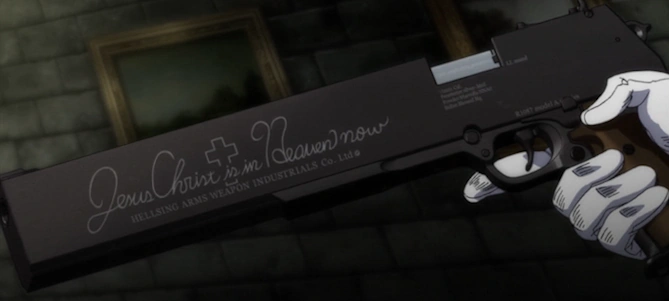
| The 13mm Jackal is a massive pistol made especially for Alucard. It had a length of 15 23⁄64", a weight of 35.3#, a black gunmetal construction, and it used massive 13mm armor-piercing explosive rounds. The words "Jesus Christ is in Heaven now" were engraved upon it, in mockery of a similar statement on Anderson's gloves. It was revealed that the Jackal had an explosive device hidden inside of it by The Professor, who could detonate it with his remote if he were to gain a significant edge against Millennium with it.
| |
Concept and Creation
| Character Conception 1 | ||||||||||||||||||||||||||||
|---|---|---|---|---|---|---|---|---|---|---|---|---|---|---|---|---|---|---|---|---|---|---|---|---|---|---|---|---|
| Kohta Hirano visualized Alucard as a character invincible to any attacks[236] and characterized him as someone who will take no chances and give no mercy in battle, and he is in no way a "hero" but an "anti-hero" or "dark hero."[237] Hirano stated that after consuming numerous human lives, Alucard's personal identity changed to the point that he no longer cares about the gender of his form. Consequently, the Control Art Restriction System was established to repress this, although he continues to take on the form of a male as his base form because his initial personality was one.[25] In addition, he clarified that Alucard's transformation into a vampire was through his own will and outside forces had no play in his transformation.[238] Hirano initially had issues with Alucard's character being too powerful, so Alexander Anderson was created. In turn, he thought about making The Captain as Alucard's equal on Millennium's side but refrained from doing so and views Millennium as an organization "not strong enough" against Alucard;[239][240] as such, Schrödinger was created as the ultimate "tool" to kill Alucard, seeing him as the only real way to end Alucard in one shot.[241] In developing the dynamic between characters, he did not see a romance between Alucard and Seras Victoria as possible; to remedy this, Hirano conceived the character of Pip Vernedead for Seras, while Alucard would develop a complex bond with Integra Hellsing.[242] Concerning his relationship with Seras, Hirano tries to convey that Seras and Alucard maintain a complex relationship with a form of love that is closer to the ties of a family than master-and-slave, although not adjacent to a father-daughter bond.[243] Nearing the end of serialization, Hirano regretted ending the fight between Alucard and Anderson prematurely, as he felt that he was attempting to wrap the series as soon as possible, harming the pacing of the series; thus, he felt the presentation of the fight could have been better.[244] Hirano states the narrative centers on Alucard's desire to be defeated by a human, making his defeat the focal point of the story. Although The Major achieved victory over Alucard, he cannot be considered fully human, which is why Alucard returned three decades later.[245]
| ||||||||||||||||||||||||||||
| Design Conception 2 | ||||||||||||||||||||||||||||
| When Alucard was conceived for Hellsing, Hirano depicted him as "a man wearing a trench coat up to his neck as some kind of neck protector, and the rest of his body acts to block any damage, including physical and from bullets," essentially attempting to create a character virtually invincible from any attacks. However, some elements of his design were changed when Alucard returned as the protagonist for the new Hellsing manga for Young King OURs, switching his trench coat to a long coat (though keeping elements of the ruffled shoulders) and making him powerful enough without needing the aid of a bullet vest.[236] The addition of a long coat and hat for Alucard assisted in differentiating him from a "formulaic vampire" that he felt would not work with a story about gunplay, yet kept his "dark" and "ominous" presence that is adjusted for his behavior.[246] For elements of Alucard's design, Hirano took inspiration from outfits worn by John Lennon and "a little bit of Vash the Stampede,"[247] a character from the Trigun series, while his sunglasses-goggles hybrid was inspired by Bolt Crank from the manga series Eat-Man and the titular character of Léon: The Professional (which led to his friends teasing him about the sunglasses worn by Alucard), on the basis that sunlight weakens vampires.[28] The similar design qualities Alucard shares with Vash the Stampede, such as the sunglasses and the stylized long coat, garnered much criticism against Hirano, leading him to humorously lament his choices for Alucard's design in the afterword of volume 1;[248] the criticism caused Hirano to update Alucard to a more stylized design, first revealed in issue 30 of Young King OURs.[28] After Alucard receives the Jackal, he uses it alongside the .454 Casull in a dual-wielding style. The Jackal has a left-facing case ejector, something most guns do not have, and this makes it appear as though the gun is meant to be used with the .454 Casull. However, Alucard is almost always shown holding the Jackal in his right hand and the .454 Casull with his left, causing the case ejectors to face each other (which would throw spent shell casings into his face). Hirano is fully aware of the inconsistency and states his indifference about drawing the weapons functionally, jokingly asserting that both the .454 Casull and the Jackal have no magazine capacity.[248][249]  Kairakuten Design  Prototype Design .png "Unknown (40).png (282 KB)") Initial Design  Stylized Design
| ||||||||||||||||||||||||||||
| Name Conception 3 | ||||||||||||||||||||||||||||
Alucard's name, which is an anagram for "Dracula,"[250] was adopted from a choose-your-own-adventure novel by Irish author J. H. Brennan.[28] In katakana, the name "Alucard" would be translated as "アルカード (Arukādo)," though midway to chapter 6, Hirano opted to switch to the unusual "アーカード (Ākādo)" instead. As such, chapters past 6 and the first tankoubon release would accommodate the change in the katakana form of "Alucard."
| ||||||||||||||||||||||||||||


Appearances
| Manga Chapters |
Mentioned only
Flashbacks only
|
| OVA Volumes |
Trivia
- Alucard's true identity—that of both the historical Vlad III and the fictional Count Dracula—is only hinted at earlier in the series.[28] Such early hints include his anagrammatic name (Alucard is Dracula, reversed), the title of the series[l] and the name of Integra's family, and most notably, his many frequent impalements of his opponents (the Vicar and Huger with his bare hands, the GATE officers in Brazil on flagpoles, Rip Van with her own musket, and hundreds of victims in London during the battlefield). From there, the hints become much less vague, and his identity as the fictional Count Dracula is brought to light. Around the Elevator Action Arc, a poster illustration depicting The Major, Integra, Alucard, Seras, and Anderson was created by Hirano, with a text above representing each character; Alucard's was written as "Dracula."[252] In volume 4, a dreaming Alucard recalls his defeat at the hands of Abraham Van Helsing, which marked the beginning of his servitude to the Hellsing family. In volume 7, the narration alludes to the Count's arrival in London aboard the Demeter, from Bram Stoker's novel Dracula (although in the novel, Dracula never came ashore in London to search for Mina as the narration implies). In volume 8, his full identity is made plain when Alucard releases Level Zero at the command of Integra, who greets him with, "Welcome back, Count." Reverting to the body he had at the time of his "death" at age 45 (as in Hellsing, Vlad III's death occurred somewhere in 1476, and he was born in 1431[24]), he summons massive hordes of souls he had devoured during the centuries.
- A young Vlad illustration was drawn by Hirano for the 2002 Hellsing calendar,[m] with a text above originating from a 1491 newspaper in Bamberg, Germany.[253]
- Historically, Vlad was responsible for the deaths of between 40,000 and 100,000 of his enemies and various villains in his own country during his reign as the Voivode of Wallachia (a major portion of what is now present-day Romania). His most well-known way of execution was Impalement. For torturing people by impalement, it is alleged that his executioners learned how to have the victims placed so that the pikes, spears, or other shafts on which they had them impaled would pass most or all of the victim's vital organs, entering their lower nether regions and exiting near the back of their neck.
- Alucard has two Paganism references on him. The first one is the pentacle symbol on his gloves. The second is his epithet, "The Bird of Hermes." Hermes was the Greek messenger god, noted for his winged sandals and ability to fly. Hermes was also noted for transporting souls to the Underworld, while Alucard, in contrast, devours them.
- "The Bird of Hermes is my name/Eating my wings to make me tame" is also part of the Ripley Scroll, a medieval work about emblematic symbolism. George Ripley was an alchemist who lived around Vlad the Impaler's time and is also said to have known the formula to create the Philosopher's Stone.
- Below the star on Alucard's gloves, it has the German words "Gott Mit Uns," which translates to "God With Us." Interestingly, those words were used by the German military until the end of World War II and during the Nazi era by the Wehrmacht (the regular German army), whereas the Nazi Waffen-SS used "Meine Ehre heißt Treue," which means "Loyalty is my Honor," instead.
- Before becoming a vampire, Alucard's eyes were a bluish-purple in the OVA. However, in his famous portrait, Vlad III has brown eyes. There are also historical records describing him as having "threatening" green eyes.[254]
- Interestingly, in the English commentary for OVA I, Crispin Freeman notes that he was originally going to give Alucard a Romanian accent, but decided on an American accent instead.
- Alucard appeared in Call of Duty: Modern Warfare II, a first-person shooter game, as a playable operator, with Crispin Freeman returning to reprise his role as Alucard.
- The character Solomon from Genndy Tartakovsky's Sym-Bionic Titan cartoon is a visual reference to Alucard.
Footnotes
Notes
- ↑ The countless lives Alucard had consumed altered the fundamentals of his identity to the point where the concept of "gender" is meaningless for him. Although his "initial personality" is a male, which is why he commonly takes a male form and is referred to as such.[25]
- ↑ For the subtitles of the OVA and the anime series, Alucard's name is spelled as "Arucard" due to the insistence of the Japanese producers that it should be kept as such. Though the English dub producers were not told to pronounce the name in a specific way, which is why "Alucard" is pronounced for the dub, while "Arucard" is kept for the subtitles.[31][32]
- ↑ Gott Mit Uns is intended to be "God with Us" or "God be with us" in German.
- ↑ In the OVA, his suit (including the buttons) and trousers are colored gray, with his shoulder ruffles extending to the back of his coat. The overall color scheme of his outfit is a lot darker, and the stripes on his hat are colored pinkish-brown. His sunglasses are colored gray with orange frames graded with red. Consistent with Hirano's earlier artworks of Alucard's hat, the OVA has Alucard's hat being a wide, floppy-brimmed fedora.
- ↑ Though the collar design did undergo a similar change in design in the OVA, the color scheme of the outfit remained consistently black, even his hair in the prelude. In the manga, the inking of the outfit is also black.
- ↑ It is also known alternatively as "Lolicard (ロリカード, Rorikādo)" by Hirano (and Japanese fans)[5] and "Chibicard (チビカード, Chibikādo)" in the OVA.[41]
- ↑ Though the colors is adapted remarkably close with Hirano's colored artworks of the form when it made its appearance in OVA IX (the only differences being a purplish-black shirt and a red tie with gold accents), previous iterations of the form were quite inconsistent in colors:
- ↑ In order for the form to be easier to animate, the pattern of the beard was slightly changed.
- ↑ Chains in its original appearance.
- ↑ Anime Expo 2005 Panel[102][103][104]
- ↑ In the OVA, the afflicted human will enter a euphoric, stupor-like state, and their eyes will glow red.[205]
- ↑ The title of "Hellsing" was chosen because one of the main characters is a descendant of Van Helsing, and a play on the word "Hell."[251]
- ↑ The line art of the illustration would also appear in the later-released guidebook.
References
- ↑ 1.0 1.1 Volume 4, Order 23: Call to Power (p. 3)
- ↑ Volume 8, Order 68: Castle vania (1) (p. 14)
- ↑ 3.0 3.1 3.2 3.3 Volume 9, Order 69: Castle vania (2) (p. 17)
- ↑ 4.0 4.1 4.2 4.3 4.4 4.5 4.6 4.7 Hellsing Official Guidebook (p. 006)
- ↑ 5.0 5.1 5.2 5.3 5.4 5.5 5.6 5.7 5.8 Hellsing Official Guidebook (p. 009)
- ↑ 6.0 6.1 6.2 6.3 Volume 1, Order 06: Sword Dancer (3) (p. 22)
- ↑ 7.0 7.1 7.2 Volume 3, Order 12: Balance of Power (2) (p. 8)
- ↑ Volume 1, Order 06: Sword Dancer (3) (p. 2)
- ↑ 9.0 9.1 Volume 1, Order 01: Vampire Hunter (p. 17)
- ↑ Volume 1, Order 05: Sword Dancer (2) (p. 11)
- ↑ 11.0 11.1 11.2 Hellsing: Ultimate II
- ↑ 12.0 12.1 Volume 1, Order 01: Vampire Hunter
- ↑ Volume 8, Order 68: Castle vania (1) (p. 11)
- ↑ 14.0 14.1 14.2 Volume 9, Order 78: Warcraft (1) (p. 16)
- ↑ Volume 1, Order 06: Sword Dancer (3) (p. 10)
- ↑ 16.0 16.1 16.2 16.3 16.4 16.5 16.6 Volume 8, Order 59: Wizardry (3)
- ↑ Volume 9, Order 70: Heart of Dream (p. 2)
- ↑ Volume 3, Order 14: Elevator Action (1) (p. 1)
- ↑ Volume 1, Order 06: Sword Dancer (3) (p. 9)
- ↑ Volume 8, Order 58: Wizardry (2) (p. 12)
- ↑ Volume 7, Order 57: Wizardry (1) (p. 16)
- ↑ Volume 5, Order 32: D (7) (p. 10)
- ↑ Volume 5, Order 31: D (6) (p. 4)
- ↑ 24.0 24.1 24.2 24.3 24.4 24.5 24.6 24.7 24.8 Kohta Hirano Super Expo (平野耕太大博覧會) — The history guide section of the exhibition is noted to be a "private chronology by a certain historian" and contains "various theories." Thus, it cannot be taken at face value.
- ↑ 25.0 25.1 25.2 25.3 25.4 Hellsing Official Guidebook (p. 151)
平野 男とか女とか、もうそういうのどうでもよくなっちゃってるんですよ。アーカード。いろんな人間の命を吸いすぎて同化吸収して、それをアーカードのパーソナルが無理矢理強力に拘束してる。だから「拘束制御術式」。もちろんアーカードは本来のバーソナルが男ですので基本は男ですけど。 (Rough Translation: It doesn't really matter anymore whether or not Alucard's a male or a female, not like he cares about his form. He's absorbed so many human lives to the point where those lives altered his personal identity. That's where the Control Art Restriction System comes into play to help suppress this. Of course, his initial personality is a male, so he's basically a male.) - ↑ "ヤングキングアワーズ 2005年10月号." Shonengahosha. August 30, 2005.
- ↑ 28.00 28.01 28.02 28.03 28.04 28.05 28.06 28.07 28.08 28.09 28.10 "HELLSING catalogue from 平野耕太." Shonengahosha. July 31, 1997.
- ↑ Hellsing: Ultimate I — Booklet Supplementary Material.
- ↑ HELLSING OVA I - V Blu-ray Box — Booklet Supplementary Material.
- ↑ 31.0 31.1 31.2 "Crispin Freeman corrects fan." Youtube. @ooBloodroseoo. April 17, 2007.
- ↑ 32.0 32.1 "Ever read the R1 subtitles? They're contractually obligated to write his name as Arucard or something.." GameFAQs.
- ↑ 33.0 33.1 Order 04: The Dawn (4) (p. 15)
- ↑ 34.0 34.1 Volume 9, Order 76: Lunatic Dawn (p. 15)
- ↑ 35.0 35.1 35.2 Hellsing: Volume 2 — Volume cover.
- ↑ Volume 1, Order 01: Vampire Hunter (pp. 20-21)
- ↑ Hellsing: Volume 10 — Volume cover.
- ↑ Hellsing: Volume 3 — Volume cover.
- ↑ Hellsing: Volume 1 — Volume cover.
- ↑ Hellsing: Volume 6 — Volume cover.
- ↑ 41.0 41.1 Hellsing: Ultimate Production Sheets
- ↑ 42.0 42.1 42.2 42.3 42.4 42.5 Volume 1, Order 02: Master of Monster
- ↑ Hellsing: Volume 9 — Volume cover.
- ↑ Volume 1, Order 06: Sword Dancer (3)
- ↑ Volume 4, Order 19: Elevator Action (6)
- ↑ 46.0 46.1 46.2 Volume 5, Order 31: D (6)
- ↑ 47.0 47.1 47.2 47.3 Volume 5, Order 32: D (7)
- ↑ 48.0 48.1 48.2 48.3 Volume 9, Order 69: Castle vania (2)
- ↑ 49.0 49.1 49.2 49.3 Volume 9, Order 74: Finesthour (2)
- ↑ 50.0 50.1 Volume 9, Order 75: Finesthour (3)
- ↑ 51.0 51.1 Volume 9, Order 76: Lunatic Dawn
- ↑ 52.0 52.1 Volume 1, Order 01: Vampire Hunter (pp. 16-24)
- ↑ 53.0 53.1 Volume 1, Order 03: Murder Club (pp. 16-17)
- ↑ 54.0 54.1 54.2 54.3 54.4 Volume 3, Order 15: Elevator Action (2) (pp. 12-18)
- ↑ 55.0 55.1 Volume 2, Order 07: Dead Zone (1) (pp. 8-9)
- ↑ 56.0 56.1 56.2 Volume 3, Order 16: Elevator Action (3) (pp. 1-11)
- ↑ 57.0 57.1 Volume 2, Order 10: Dead Zone (4)
- ↑ 58.0 58.1 Volume 3, Order 15: Elevator Action (2)
- ↑ Volume 3, Order 15: Elevator Action (2) (p. 25)
- ↑ Hellsing Official Guidebook (p. 190)
- ↑ Volume 3, Order 15: Elevator Action (2) (pp. 28-29)
- ↑ 62.0 62.1 62.2 62.3 Hellsing Official Guidebook (p. 008)
- ↑ Hellsing Official Guidebook (p. 021)
- ↑ Volume 6, Order 42: Aubird Force (pp. 17-19)
- ↑ Volume 9, Order 73: Finesthour (1) (p. 9)
- ↑ Volume 1, Order 05: Sword Dancer (2) (pp. 17-18)
- ↑ Volume 9, Order 74: Finesthour (2) (p. 7)
- ↑ 68.0 68.1 Volume 3, Order 13: Balance of Power (3) (pp. 15-17)
- ↑ 69.0 69.1 Volume 8, Order 65: Might and Magic (1) (p. 9)
- ↑ Volume 3, Order 15: Elevator Action (2) (p. 28)
- ↑ 71.0 71.1 Volume 9, Order 76: Lunatic Dawn (p. 16)
- ↑ Volume 3, Order 13: Balance of Power (3) (p. 7)
- ↑ Volume 4, Order 23: Call to Power (p. 12)
- ↑ Volume 8, Order 64: Hundred Swords (3) (p. 3)
- ↑ 75.0 75.1 75.2 75.3 75.4 Volume 8, Order 65: Might and Magic (1) (pp. 8-10)
- ↑ Volume 3, Order 15: Elevator Action (2) (p. 16)
- ↑ Volume 9, Order 69: Castle vania (2) (p. 11)
- ↑ 78.0 78.1 Volume 8, Order 63: Hundred Swords (2) (p. 6)
- ↑ 79.0 79.1 79.2 79.3 79.4 Volume 8, Order 64: Hundred Swords (3) (pp. 2-3)
- ↑ 80.0 80.1 Hellsing Official Guidebook (p. 019)
- ↑ Volume 4, Order 23: Call to Power (p. 4)
- ↑ 82.0 82.1 Volume 9, Order 69: Castle vania (2) (pp. 22-23)
- ↑ 83.0 83.1 Volume 8, Order 61: Wizardry (5) (pp. 8-12)
- ↑ 84.0 84.1 Volume 9, Order 73: Finesthour (1) (p. 24)
- ↑ 85.0 85.1 85.2 Volume 10, Order 89: Romancia
- ↑ Volume 1, Order 05: Sword Dancer (2) (p. 15)
- ↑ Volume 8, Order 68: Castle vania (1) (pp. 2-5)
- ↑ 88.0 88.1 88.2 Hellsing Official Guidebook (p. 027)
- ↑ Volume 8, Order 68: Castle vania (1) (pp. 7-8)
- ↑ Volume 8, Order 68: Castle vania (1) (p. 8)
- ↑ Volume 8, Order 68: Castle vania (1) (pp. 7-9)
- ↑ Volume 8, Order 68: Castle vania (1) (pp. 9-10)
- ↑ 93.0 93.1 Volume 8, Order 68: Castle vania (1) (pp. 10-14)
- ↑ 94.0 94.1 94.2 Volume 8, Order 68: Castle vania (1)
- ↑ 95.0 95.1 Volume 10, Order 83: Black Onyx (2) (pp. 1-6)
- ↑ Hellsing Official Guidebook (p. 033)
- ↑ Volume 7, Order 57: Wizardry (1) (pp. 21-23)
- ↑ 98.0 98.1 Hellsing: Ultimate X — Booklet Supplementary Material.
- ↑ 99.0 99.1 Hellsing Official Guidebook (p. 032)
- ↑ Volume 8, Order 64: Hundred Swords (3) (p. 23)
- ↑ Hellsing Official Guidebook (p. 024)
- ↑ "A few things about the panel." LiveJournal.
- ↑ "AxS: Canon or Fanon and in What Sense? Hirano's Interview, Original Artwork and AxS Sites." LiveJournal.
- ↑ "Relationship with Alucard." Wikipedia.
- ↑ 105.0 105.1 105.2 Hellsing Official Guidebook (p. 022)
- ↑ 106.0 106.1 Volume 9, Order 74: Finesthour (2) (p. 1)
- ↑ 107.0 107.1 Hellsing Official Guidebook (p. 011)
- ↑ 108.0 108.1 Volume 4, Order 21: Age of Empire (2) (p. 13)
- ↑ Volume 9, Order 73: Finesthour (1) (pp. 9-11)
- ↑ Hellsing Official Guidebook (p. 034)
- ↑ Hellsing Official Guidebook (p. 189)
- ↑ Volume 8, Order 61: Wizardry (5) (pp. 8-10)
- ↑ Volume 3, Order 12: Balance of Power (2) (pp. 8-9)
- ↑ Volume 10, Order 83: Black Onyx (2) (pp. 12-15)
- ↑ Hellsing Official Guidebook (p. 035)
- ↑ Volume 1, Order 01: Vampire Hunter (p. 30)
- ↑ Volume 3, Order 13: Balance of Power (3) (p. 15)
- ↑ Volume 3, Order 13: Balance of Power (3) (pp. 16-17)
- ↑ Hellsing Official Guidebook (p. 023)
- ↑ Volume 3, Order 13: Balance of Power (3) (p. 17)
- ↑ Volume 8, Order 68: Castle vania (1) (p. 16)
- ↑ Volume 9, Order 69: Castle vania (2) (pp. 1-8)
- ↑ Hellsing Official Guidebook (p. 075)
- ↑ Volume 4, Order 21: Age of Empire (2) (pp. 17-26)
- ↑ Hellsing Official Guidebook (p. 079)
- ↑ Hellsing Official Guidebook (p. 080)
- ↑ 127.0 127.1 Volume 8, Order 62: Hundred Swords (1) (pp. 6-7)
- ↑ Volume 9, Order 79: Warcraft (2) (p. 9)
- ↑ Volume 8, Order 65: Might and Magic (1)
- ↑ Hellsing Official Guidebook (p. 053)
- ↑ 131.0 131.1 Hellsing Official Guidebook (p. 081)
- ↑ Volume 9, Order 70: Heart of Dream (pp. 2-3)
- ↑ Volume 9, Order 70: Heart of Dream (pp. 4-5)
- ↑ Volume 9, Order 70: Heart of Dream (p. 9)
- ↑ Volume 9, Order 70: Heart of Dream (pp. 10-16)
- ↑ Volume 9, Order 71: Relics (pp. 1-2)
- ↑ Volume 9, Order 71: Relics
- ↑ Volume 9, Order 73: Finesthour (1) (p. 1)
- ↑ Hellsing Official Guidebook (p. 191)
- ↑ Volume 8, Order 68: Castle vania (1) (pp. 14-15)
- ↑ Volume 8, Order 59: Wizardry (3) (pp. 16-20)
- ↑ Volume 7, Order 57: Wizardry (1) (p. 21-23)
- ↑ Volume 4, Order 23: Call to Power (pp. 1-3)
- ↑ Volume 10, Order 88: Oblivion (p. 8)
- ↑ 145.0 145.1 Hellsing Official Guidebook (p. 025)
- ↑ The Dawn (arc)
- ↑ Volume 4, Order 20: Age of Empire (1) (pp. 6-7)
- ↑ Volume 4, Order 23: Call to Power (pp. 13-14)
- ↑ Volume 9, Order 72: Heart of Iron (p. 8)
- ↑ Volume 9, Order 72: Heart of Iron (pp. 7-8)
- ↑ 151.0 151.1 Volume 2, Order 09: Dead Zone (3) (p. 25)
- ↑ Volume 5, Order 31: D (6) (p. 19)
- ↑ 153.00 153.01 153.02 153.03 153.04 153.05 153.06 153.07 153.08 153.09 Hellsing Official Guidebook (p. 007)
- ↑ Volume 8, Order 58: Wizardry (2) (pp. 12-14)
- ↑ Volume 8, Order 59: Wizardry (3) (p. 3)
- ↑ 156.0 156.1 156.2 Volume 1, Order 01: Vampire Hunter (pp. 18-21)
- ↑ 157.0 157.1 157.2 Volume 5, Order 32: D (7) (pp. 11-20)
- ↑ 158.0 158.1 158.2 158.3 158.4 158.5 158.6 158.7 Volume 4, Order 19: Elevator Action (6) (p. 3)
- ↑ 159.0 159.1 159.2 159.3 Volume 6, Order 45: Soldier of Fortune (1) (p. 10)
- ↑ Volume 2, Order 07: Dead Zone (1) (p. 10)
- ↑ Elevator Action Arc
- ↑ Volume 4, Order 19: Elevator Action (6) (p. 21)
- ↑ Volume 1, Order 02: Master of Monster (pp. 18-20)
- ↑ Volume 3, Order 15: Elevator Action (2) (pp. 20-22)
- ↑ 165.0 165.1 Volume 5, Order 32: D (7) (pp. 18-21)
- ↑ 166.0 166.1 Volume 3, Order 18: Elevator Action (5)
- ↑ 167.0 167.1 Volume 1, Order 05: Sword Dancer (2)
- ↑ Volume 5, Order 33: D (8) (pp. 10-15)
- ↑ 169.0 169.1 Volume 5, Order 31: D (6) (pp. 14-16)
- ↑ Volume 5, Order 32: D (7) (pp. 1-21)
- ↑ Volume 9, Order 74: Finesthour (2) (pp. 5-8)
- ↑ Volume 3, Order 18: Elevator Action (5) (p. 26)
- ↑ Volume 1, Order 05: Sword Dancer (2) (p. 10)
- ↑ 174.0 174.1 Hellsing: Ultimate I
- ↑ Volume 3, Order 12: Balance of Power (2)
- ↑ Volume 3, Order 13: Balance of Power (3)
- ↑ Volume 5, Order 34: D (9) (p. 4)
- ↑ 178.0 178.1 Volume 4, Order 19: Elevator Action (6) (pp. 25-27)
- ↑ Volume 5, Order 34: D (9) (pp. 5-6)
- ↑ Volume 1, Order 06: Sword Dancer (3) (pp. 9-10)
- ↑ Volume 9, Order 77: Operation Wolf (pp. 23-28)
- ↑ Volume 1, Order 05: Sword Dancer (2) (pp. 15-18)
- ↑ Volume 1, Order 02: Master of Monster (pp. 28-29)
- ↑ Volume 3, Order 18: Elevator Action (5) (p. 16)
- ↑ Volume 7, Order 53: Yaksa (pp. 12-14)
- ↑ Order 04: The Dawn (4) (p. 16)
- ↑ Volume 1, Order 04: Sword Dancer (1) (p. 25)
- ↑ 188.0 188.1 188.2 Volume 9, Order 78: Warcraft (1) (p. 4)
- ↑ Volume 5, Order 32: D (7) (pp. 16-20)
- ↑ Volume 8, Order 59: Wizardry (3) (pp. 7-10)
- ↑ Volume 2, Order 11: Balance of Power (1) (p. 14)
- ↑ Volume 9, Order 76: Lunatic Dawn (p. 11)
- ↑ 193.0 193.1 Volume 1, Order 03: Murder Club (p. 16)
- ↑ Volume 1, Order 06: Sword Dancer (3) (pp. 21-24)
- ↑ Volume 5, Order 34: D (9) (p. 3)
- ↑ Volume 5, Order 30: D (5) (p. 9)
- ↑ Hellsing: Ultimate IV
- ↑ Volume 3, Order 13: Balance of Power (3) (p. 18)
- ↑ Volume 3, Order 15: Elevator Action (2) (p. 23)
- ↑ Volume 3, Order 17: Elevator Action (4) (pp. 22-26)
- ↑ Volume 6, Order 42: Aubird Force (pp. 14-15)
- ↑ Volume 7, Order 57: Wizardry (1) (pp. 19-20)
- ↑ 203.0 203.1 Volume 3, Order 14: Elevator Action (1) (pp. 4-5)
- ↑ 204.0 204.1 Volume 3, Order 17: Elevator Action (4) (pp. 10-12)
- ↑ Hellsing: Ultimate III
- ↑ Volume 3, Order 14: Elevator Action (1) (p. 5)
- ↑ Hellsing Official Guidebook (p. 181)
- ↑ Volume 3, Order 18: Elevator Action (5) (pp. 19-20)
- ↑ Volume 8, Order 58: Wizardry (2) (pp. 1-7)
- ↑ Volume 7, Order 57: Wizardry (1) (pp. 19-22)
- ↑ Volume 7, Order 57: Wizardry (1) (pp. 22-24)
- ↑ 212.0 212.1 212.2 Volume 10, Order 81: Wolf Fang (2) (pp. 8-9)
- ↑ Hellsing Official Guidebook (p. 026)
- ↑ Volume 7, Order 55: Ogre Battle (p. 8)
- ↑ Volume 8, Order 59: Wizardry (3) (p. 15)
- ↑ Hellsing Official Guidebook (p. 184)
- ↑ Volume 9, Order 78: Warcraft (1) (p. 9, 11)
- ↑ Volume 8, Order 59: Wizardry (3) (p. 16)
- ↑ Hellsing Official Guidebook (p. 026)
般に吸血鬼は心臓に杭を打ち込むこと で死ぬとされているが、アーカードは全身 に銃剣を突き刺されたうえで首を落とされ ても死なない。なぜなら、それはただ「アー カードの中のひとつの命が死ぬ」ことに過ぎ ないからである。(Rough Translation: Although it is generally believed that vampires die by driving a stake through their heart, Alucard does not die even when multiple bayonets is thrust through his entire body and he is decapitated. This is because it is nothing more than "one of the many lives inside Alucard dying." - ↑ Hellsing Official Guidebook (p. 026)
不死の王アーカードを倒すには、彼の中 に存在する命のすべてを殺さねばならない。 しかし、彼がこれまでに取り込んだ命は無 数であり、これからも命を取り込み続ける 限りアーカードは無敵とされている。(Rough Translation: In order to defeat Nosferatu Alucard, one must kill all life that exists within him. However, the number of lives he has taken so far is countless, and as long as he continues to take lives, Alucard is considered invincible.) - ↑ Volume 8, Order 61: Wizardry (5) (p. 5)
- ↑ Volume 8, Order 65: Might and Magic (1) (p. 22)
- ↑ Volume 9, Order 78: Warcraft (1) (p. 15)
- ↑ 224.0 224.1 Volume 10, Order 82: Black Onyx (1) (pp. 7-8)
- ↑ 225.0 225.1 Volume 10, Order 83: Black Onyx (2) (pp. 9-11)
- ↑ Volume 10, Order 83: Black Onyx (2) (p. 10)
- ↑ Hellsing Official Guidebook (p. 091)
- ↑ 228.0 228.1 Volume 10, Order 89: Romancia (pp. 25-26)
- ↑ Volume 2, Order 10: Dead Zone (4) (p. 5)
- ↑ 230.0 230.1 Volume 8, Order 60: Wizardry (4)
- ↑ 231.0 231.1 Hellsing Official Guidebook (p. 036)
- ↑ Volume 10, Order 89: Romancia (p. 26)
- ↑ Volume 2, Order 09: Dead Zone (3)
- ↑ Volume 5, Order 29: D (4) (pp. 16-20)
- ↑ Volume 5, Order 30: D (5) (pp. 11-16)
- ↑ 236.0 236.1 Hellsing Official Guidebook (p. 148-149)
平野 吸血鬼、みんな好きでしょ。僕も好きだったので。んでただでさえ強い吸血鬼が改造されて銃持って来たら、やでしょ。最初のほうで描いてた主人公の服は、首まであるトレンチコートの襟立て止めみたいなので。全身覆っててそれが挙句防弾、という、ずるいよお前っていうキャラを作ろうと思ってたんですよ。でもあまりにダサかったのでロングコートに変えて、防弾というよりはそんなんもうどーでもいいキャラってことになりました。それが今の形というか、有様です。(Rough Translation': Everyone loves vampires, right? I love them too. So imagine if a vampire—who's already super strong—got modified and started carrying a gun. That'd be something, wouldn't it? The outfit I was drawing for the protagonist early on was like a man wearing a trench coat up to his neck as some kind of neck protector, and the rest of his body acts to block any damage, including physical and from bullets—I was trying to create a character that made you think, "You're cheating!" But it looked way too dorky, so I switched it to a long coat, and instead of being bulletproof, he just became a character where none of that really matters anymore. That's basically his current form—or rather, his current state.) - ↑ Beckett Anime Issue #89 (p. 51)
Hirano: They are indeed anti-heroes. They will take no chances and give no mercy in a battle. They'll also do whatever it takes to get what they want. They are in no way, shape or form "heroes." They're anti-heroes or "dark" heroes. - ↑ Hellsing Official Guidebook (p. 150)
平野 後者です。自分で吸血鬼になった。誰かからして貰ったり、ただ単に生まれながらにして自然に吸血鬼になったのではなく自分の意思で吸血鬼と化したのです。 (Rough Translation: The latter. He became a vampire of his own accord. He didn’t have someone turn him into one, nor was he simply born a vampire; he simply transformed into a vampire of his own free will.) - ↑ Hellsing Official Guidebook (pp. 172-173)
平野 アンデルセンがいなければ、第13課がヘルシング機関に対抗できるような組織にはならなかったんです。キャラひとりひとりが弱すぎて。なので、アーカードと対になるキャラを、と思いアンデルセンを作りました。そういう点から見ると、ミレニアムにはアーカードと対になるキャラがいないんですよ。大尉をそのポジションに置こうとも考えたんですが、実は大尉はそこまで強くはない。アーカードVSアンデルセンの戦いに大尉が参入したところで勝ち目はない気がします。だから、ミレニアムは悪役組織の主軸なのに、アーカードに対抗できるだけの戦力はいないという、可哀想なことになる。 (Rough Translation: Frankly, Section 13 would never have become an agency capable of rivaling the Hellsing Agency without Anderson. Every character was too weak, so I conceived Anderson with the intention of making him a rival to Alucard. So from the perspective, Millennium doesn't really have a character who can match up to Alucard's strength. Although I did consider putting The Captain in that role, but the truth is, The Captain isn't actually that strong. I don't even think he stands a chance if he were to join the battle between Alucard and Anderson. That's why, even though Millennium is the central evil organization, it ends up in this pitiful situation where it lacks the combat power to stand up to Alucard.) - ↑ Hellsing Official Guidebook (p. 173)
平野 対ミレニアムではアーカードはそんなに苦戦していないんですよ。だいたい一方的にフルボッコにして、あとは二タニタして終わりですから。少佐の絡め手で一時的に倒されましたが、実際にはライバルと呼べるほどのキャラはミレニアムにはいませんでしたね。 (Rough Translation: Well, against Millennium, Alucard doesn't really seem to struggle against them. It just basically turns into a one-sided beat down, grinning, and then it's over. He was temporarily defeated by The Major's trap, but in the end, there wasn't really anyone in Millennium who could be called a true rival.) - ↑ Hellsing Official Guidebook (p. 160)
平野 シュレディンガーは、初めからアーカードを殺すための道具として考えたキャラクターでした。だってもう、他に殺す方法がないもん。長い時間をかければ殺せるんですけど、一発で殺すにはああいう形で「生きてもいないし死んでもいない」状態にするしかない。 (Rough Translation: Schrödinger was a character I created from the very beginning as a tool for killing Alucard. Sure, I could kill him multiple times but there was really one way to kill him with a one-shot, that is to make him "alive-nor-dead" in a way.) - ↑ Hellsing Official Guidebook (p. 170)
平野 それは初めから想定していた流れでした。組み合わせとして「アーカード &セラス」というのは有り得なかったので、ベルナドットはセラスとくっつけるために登場させたんです。「アーカード &インテグラ」、「ベルナドット&セラス」 という組み合わせは、ストーリーが三分の一くらい進んだ辺りでもう決めていました。そこは揺るがない展開でしたね。 (Rough Translation: Yes, that flow of the story was something that was decided on from the beginning. Since the pairing of "Alucard & Seras" just wasn't a possibility, I wrote in Vernedead specifically to pair him with Seras. I pretty much had the pairings—"Alucard & Integra" and "Vernedead & Seras"—figured out by the time the story was about a third of the way through. That was a plot point that never wavered.) - ↑ Otakon 2006 Interview
Interviewer: What's the exact relationship between Alucard and Seras?
Hirano: It's very hard to distinguish that difference. At first, they were saying it should be master-and-slave, but then they changed their minds because they said "no, no, master-and-slave is the relationship between Alucard and Integra." So, we cannot call Alucard and Seras master-and-slave. Maybe it is "part of the same kind," comrades, or, from Seras's point of view, probably Alucard is the master, teacher. They're... feeling-wise, emotion-wise, it will be more close to either... Certainly, of course there is the feeling of the love, but also, it could be something more close to the ties of familiship.
Interviewer: That means that Alucard and Seras is more like a father-daughter bond.
Hirano: There's no one way to distinguish how they feel about it. We cannot just say it's just father and daughter. Many things mix together. It's very complicated. - ↑ Hellsing Official Guidebook (pp. 171-172)
平野 アンデルセンとマクスウェルは好きでした。ただ、後から考えてみると、アンデルセンはもう少し見せ場が欲しかったかな、と。コミックス8巻からは、とにかく早く決着をつけさせようとして少し早足になってしまったんです。アーカードVSアンデルセンと、セラスVS 大尉は、もっと良い戦い方、見せ方があったはずで、ただ、そう思うのはあくまでももう描き終わったからで、描いていた当時はあれが限界でしたね。 (Rough Translation: Asking who, I really liked Anderson and Maxwell. So when I look back, I feel like Anderson could have used a little more room. By volume 8, I was too eager to wrap things up quickly, so the pacing ended up feeling a bit rushed. The battles involving Alucard and Anderson and Seras and The Captain could have been handled and presented much better. But of course, I only realize that now that I’ve finished drawing them; at the time, that was the best I could do.) - ↑ Hellsing Official Guidebook (p. 160)
平野 アーカードは人間にしか倒せない、というのが作品の根っこだったので。化物になったものは人間に倒されるのがすべての基本的な流れなんですよ。少佐に関しても、彼自身は「人間だ」と言っていますが、インテグラからしてみたらどう見ても化物じゃないですか。だから、人間であるインテグラに倒された。ただ、アーカードから見れば少佐は人間なので、一時的ではありますが彼に倒される形になりました。それでも、やっぱり少佐はもう人間とは言えませんよね。だからアーカードを完全に殺すことは出来なかったんです。 (Rough Translation: The main focal point of the story was that Alucard can only be defeated by a human. That’s the fundamental narrative: anything that is a monster is ultimately defeated by a human. As for The Major, while he claims to be human, from Integra's perspective, he is a monster. That is why he was defeated by Integra, who is a human. However, from Alucard's perspective, The Major is human, which is why he was temporarily defeated by him. But The Major could not be considered 100% human, which is why Alucard was not killed completely.) - ↑ Dewey, Jim. "Hellsing Ultimate OVA —Hell Has a Fresh New Look— Interview: Kouta Hirano / Yasuyuki Ueda." Play (No. 45, pp. 84-85). Future Publishing. September 2005.
- ↑ Manga Magazine Interview (Japan Expo 2016)
What was your inspiration for the character of Alucard?
Kohta Hirano: It's John Lennon in the thug version, and a bit of Vash the Stampede. - ↑ 248.0 248.1 Hellsing: Volume 1
- ↑ Hellsing Official Guidebook
平野 適当だよ適当。アーカードの使う ジャッカルなんか適当もいいとこで、右 手で撃っているのを右側から描いた絵で は右側に排莢口があるのに、左側からの アングルでは左側にも排莢口があったり して。絵的に映えればあとはどうでもい いんだよ。弾の装填数も無限だよ。文句 あるなら男たちの挽歌に言え。ミレニア ムの吸血鬼兵たちが一斉に屋敷に攻め 入ってくる場面。あそこで、ベルナドッ トがねえし。そっとしておいてくれ。(Rough Translation: There's nothing I like in particular... The Jackal that Alucard uses is not even close to being accurate or functional. The picture of him firing with his right hand from the right side shows the casing opening on the right side, but the angle from the left side shows the casing opening on the left side as well. To me, it doesn't matter if it's accurate or not; it just has to look good in the picture. The Jackal doesn't have any ammo capacity. It's infinite. If you have a problem with that, go cry. The scene where the Millennium's vampire soldiers attack the manor all at once. In that scene, Vernedead uses the directional anti-personnel mine, the Claymore. It's not like he would really destroy tankers in a big explosion like that.) - ↑ Hellsing Official Guidebook (p. 185)
- ↑ "平野耕太 パリで「HELLSING」を語る." AnimeAnime.jp. July 7, 2008.
- ↑ "ヤングキングアワーズ 2000年(平成12年)10." Shonengahosha. August 30, 2000.
- ↑ "File:Vlad Tepes - Blatt 1.jpg." Wikimedia Commons.
- ↑ Ouellette, Jennifer. "Scientists find evidence that Vlad the Impaler shed bloody tears." Ars Technica. August 22, 2023.
| |||||||||||||||


